


How to Learn Mandarin Chinese
Most people who set out to learn Mandarin give up convinced they just aren’t built for languages. They’re wrong. (Mandarin is the standard spoken form of Chinese, so when people say they want to learn Chinese, this is almost always what they mean.) Mandarin is learnable — by you, as an adult — the way you learned your first language: in the same developmental sequence a child goes through, one stage at a time. Get the sequence right and the rest is mostly patience. Get it wrong — by starting where school starts, with characters and grammar rules — and you hit a glass ceiling: perhaps able to pass a test but still unable to understand or speak. This guide lays out how to learn Chinese the right way — the whole path required, using your brain the way it’s built to — and points to a deeper dive on each step. It’s the how-to companion to our main Learn Mandarin Chinese page, where the whole approach comes together.
Is Mandarin actually hard? The honest reframe
It’s different, not hard. Definitely not impossible. People assume Mandarin is hard because of two things — the tones and the writing system. But step back: more than a billion people speak Mandarin, and most of them in China learned it as their common tongue on top of a home variety like Cantonese or Fujianese. By 2020, over 80% of China’s population spoke Putonghua — up from about half in 2000 — and for huge numbers of the people in China it is effectively a second language. If hundreds of millions of people can pick it up as their second language, so can you. The barrier was never the language. The barrier has always been the method.
Learn in the sequence a child actually goes through
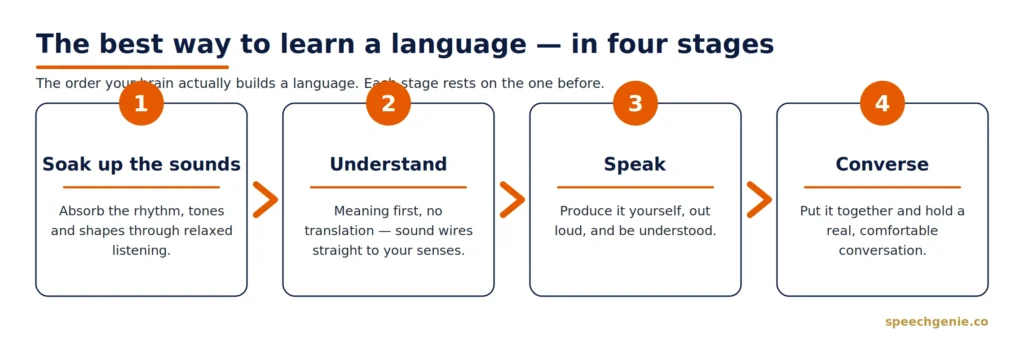
That’s the key. This idea — learning in the same sequence as a child — is the spine of the only method that is actually proven to generally work. After all, it’s how every human being who ever lived learned their first language — and how millions have gone on to master others without ever setting foot in a classroom. Children don’t begin with grammar tables or by reading. They pass through specific developmental stages, in order — and the order is not optional. Skip one and you build on sand; that is the glass ceiling so many adult learners slam into. The stages:
- Soak up the sounds. Before meaning, before writing, you tune your ear to Mandarin’s sounds and tones — what I call brainsoaking.
- Connect sound to meaning. Comprehensible input, ideally in a designed environment, so sound maps straight to meaning with no translation in the middle.
- Speak. Open your mouth and build the physiology of Mandarin — copy sounds, get the tones into your mouth, produce simple language.
- Converse. Put it together in a real, comfortable conversation.
Each stage rests on the one before it. Do them all, in order, and you will be surprised at the results. That single discipline is the difference between people who reach conversational Mandarin and people who stall forever at the glass ceiling.
It’s not just “input” — it’s training the correct brain components
You’ll hear a lot about “comprehensible input,” and it matters — but it is just one part of the method, not the whole of it. Real acquisition trains specific brain components in sequence: the ear that hears the sounds, the mouth that makes them, and the wiring that ties sound to meaning. Comprehensible input feeds the meaning piece. It does nothing for your mouth if you never open it. Keeping the whole machine in view — not just one part — is what dissolves that glass ceiling long before you ever get anywhere near it.
Why immersion alone isn’t enough
Moving to China, or streaming hours of Mandarin TV, is brainsoaking — and it genuinely helps tune your ear. But immersion is useless if you can’t connect what you hear to meaning. You need the second piece: something that ties the sounds to meaning. For adults, a designed environment makes that far easier than hoping it happens by osmosis. Language to Body — a digital version of Total Physical Response that I developed — is one example: it connects Mandarin sound directly to physical meaning, the way a child connects the word “hot” to the heat of a stove.
The building blocks — in the right order
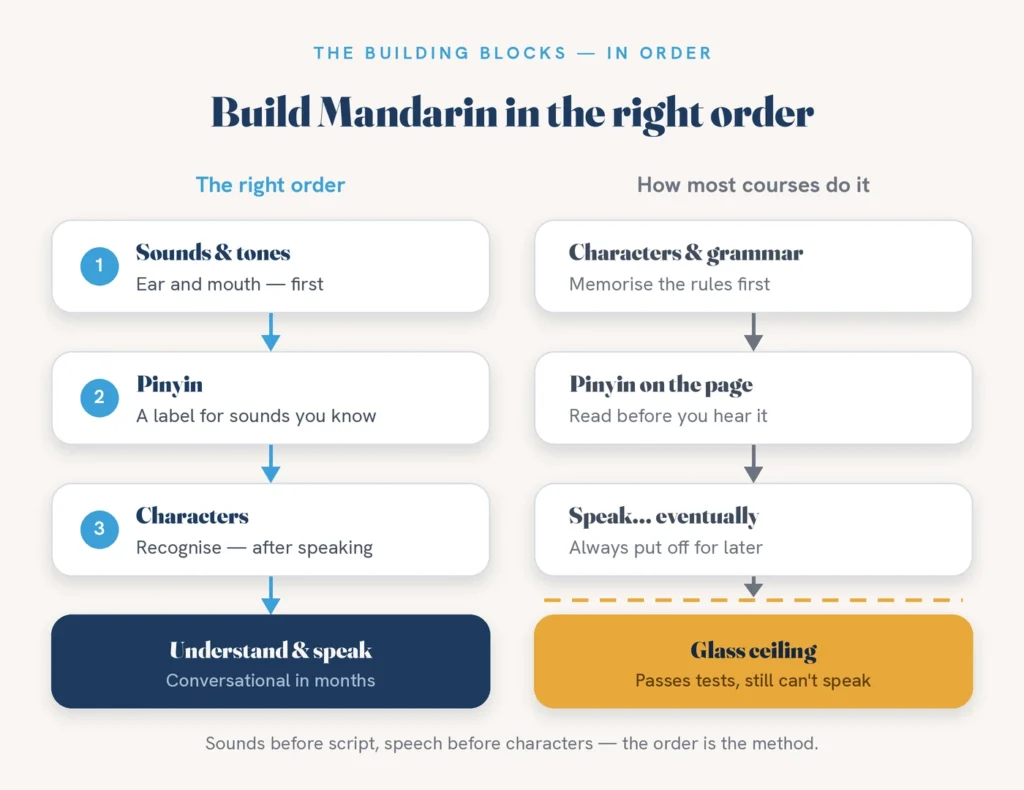
This is where most courses get it exactly backwards. The order is sounds first, then a written label, then characters.
- Sounds and tones first — in your ear and in your mouth. Learn the tones the way Chinese children do, by hearing and copying, not by memorising rules about them.
- Pinyin as a label — pinyin is genuinely useful for anyone who reads a Roman script, because it activates a skill you already have. But never start by reading pinyin: your assumptions about how those letters sound come from English (or Spanish, or French) and they are wrong for Mandarin. Get the sounds into your ear and mouth first, then add pinyin as a label for sounds you already know.
- Characters, after you can speak — Chinese children learn to write only after they can already speak, and so should you. Begin by recognising characters first, not writing them. Connect them to meanings that you have already mastered with the sounds, then begin the path of learning characters using the thinking and approach used by native Chinese speakers. That part is actually a lot of fun!
Speak from day one — what that really means
“Speak from early” does not mean forcing full sentences on day one. It means opening your mouth straight away — copying sounds, connecting what comes out of your mouth to what you hear, building the physiology of Mandarin in your mouth and throat. The words and the sentences come naturally once that machinery is in place.
How long does it take?
Comfortably conversational in around six months is realistic with the right method — far sooner than the years the traditional route implies, and sooner than the fearsome reputation learning Chinese carries would suggest. The full breakdown is in the guide on how long it takes to learn Mandarin.
Apps, classes and tutors — what actually helps
Honestly: apps are fine for a daily habit and a few words, but most are gamified vocabulary drills — a supplement, not a method. Classes add structure and accountability, but a class built on grammar-translation inherits that approach’s flaws. Tutors and language exchange are valuable once you can already understand a little — they’re practice, not a foundation. None of them replaces getting the sequence right.
Can you self-study Mandarin?
Yes — and self-study can be faster than a classroom, because you set the pace and put your effort exactly where it’s needed. What you need is good input, a way to connect sound to meaning, and the chance to open your mouth and self-correct. If you’d rather start learning Mandarin online, the same rules apply: sequence first, sounds before script.
Two quick decisions
Mandarin or Cantonese? Mandarin is the default — it’s the language of mainland China, Taiwan and Singapore, and increasingly of Hong Kong too. (I’d once have said “Cantonese if you’re in Hong Kong”; less so today.) And for speakers of Cantonese and other Chinese languages, Mandarin already functions as a kind of second language, so you’re in good company learning it as yours.
Simplified or traditional characters? Simplified characters were created to spread literacy, because many people found traditional ones genuinely hard — and today most readers in mainland China and Singapore use simplified, so that’s the practical default. Traditional characters are richer in some ways, since the radical combinations carry more visual meaning, and being able to read both is the ideal end state.
Does this really work?
It isn’t a theory. I reached fluency in Mandarin as an adult in six months, got to native level in less than two years, and learned Cantonese in four months — by going through the stages above, not the way schools teach. When I built a course on this method at Bainian Vocational School in Beijing, passing rates went from 5% to 67% in two months. My TEDx talk on this approach has been watched more than 37 million times, and I’ve written up exactly how I learned Mandarin in six months.

That is what Language to Body and Speech Genie are built to give you: the right sequence for learning Chinese, in something you can use today. Pick Mandarin and learn your first real sounds in your browser — free, no sign-up. Start playing below!
Play the lesson full-screen
On a phone the lesson works best on its own screen. Tap below to open it, then come back here when you’re done.
▶ Play the lesson →Tip: turn your phone sideways for more room.About the author
Chris Lonsdale (龍飛虎) is a psychologist, linguist and educator who reached fluency in Mandarin as an adult in six months, got to native level in less than two years, and learned Cantonese in four months. He developed Language to Body, a digital form of Total Physical Response, and created the Kungfu English learning system that Speech Genie is built on. His TEDx talk, “How to Learn Any Language in Six Months,” has been watched more than 37 million times. More at chrislonsdale.com.