
| |

Understanding isn’t just memorization

We learn all the time, continuously, regardless of our age. We never stop, but would it surprise you that many scientists propose the model where we stop learning while we are young? That is false, although more research would help prove the point. We just need some people to use experimental science!

Inside view of the ground floor of a Starbucks in Tokyo – wow! The perfect venue to learn more about language and our ability to understand — with coffee!


OK, how can I claim that learning doesn’t stop while we are young? Why so confident?

Do you know the (made up) word Preada? It’s a brand that sells glasses, like Prada. Preada puts additional effort (E) into the designs of Prada, making the name PraEda! Now, if those sentences mean nothing to you, you haven’t learned anything, but if you have now heard of Praeda, you have learned a new word that represents a fictitious company. QED: we keep learning as seen with our ability to learn new words in communications.

Why is today’s statistical AI doomed to failure? Because the uses of language are infinite, the goal of finding an example of every kind of communication (to provide accurate recognition) is doomed to failure.

Let’s see what I learned at the Tokyo Starbucks!
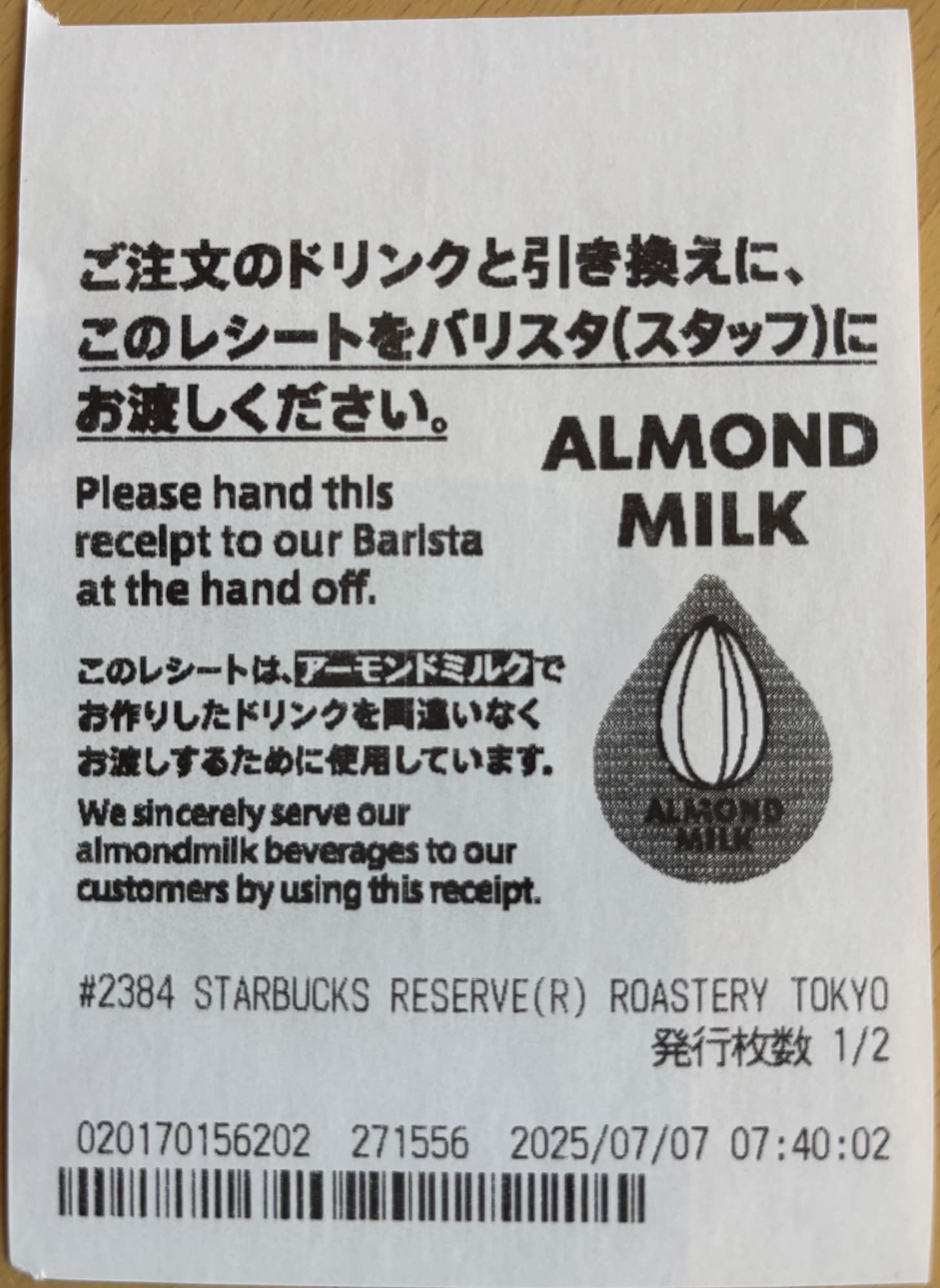
 

“Please hand this receipt to our Barista at the hand off.” Nope, that’s not great English, but I understand it perfectly. When we order drinks at a coffee shop, I know that they make the drink and call my name (or activate a ringing device) to alert me it is ready to pick. At the pick up (the hand off of my drinks), I need to provide my receipt to the barista.

I understand a massive amount about the process in question and can understand the change in perspective from my handoff (what I give up) to their handoff (what they give me).

It is like rocket science: language understanding deals with a very large number of considerations in dealing with the real world. The interactions back in the 1980s were called things like ‘scripts’ and ‘frames.’ The UC Berkeley FrameNet system seeks to document these kinds of “frames.”

If you are too old to learn, let me translate the second sentence for you: “We sincerely serve our almondmilk beverages to our customers by using this receipt.” This means:

“Please swap this receipt for your almond milk coffee.”

Really. There is some sincerity I left out, but the receipt doesn’t cause the drink to be served! I translated the word “almondmilk” into two words “almond” and “milk.”

The vast scope of my understanding of the situation allows me to effortlessly convert non-standard English into a crystal clear, unambiguous request. Based on brain observations over many years that led to the formation of Patom Theory, we can replicate this without ever needing to store multiple instances of language to recognize new forms of the language. We can learn words on the fly as well as phrases and different perspectives of events!

Let’s do one more example to show our amazing skill at decoding messages in language. Note: I will not attempt to recognize the Japanese language here since I not only don’t recognize the characters, but also the words, phrases and meanings of the relationships!
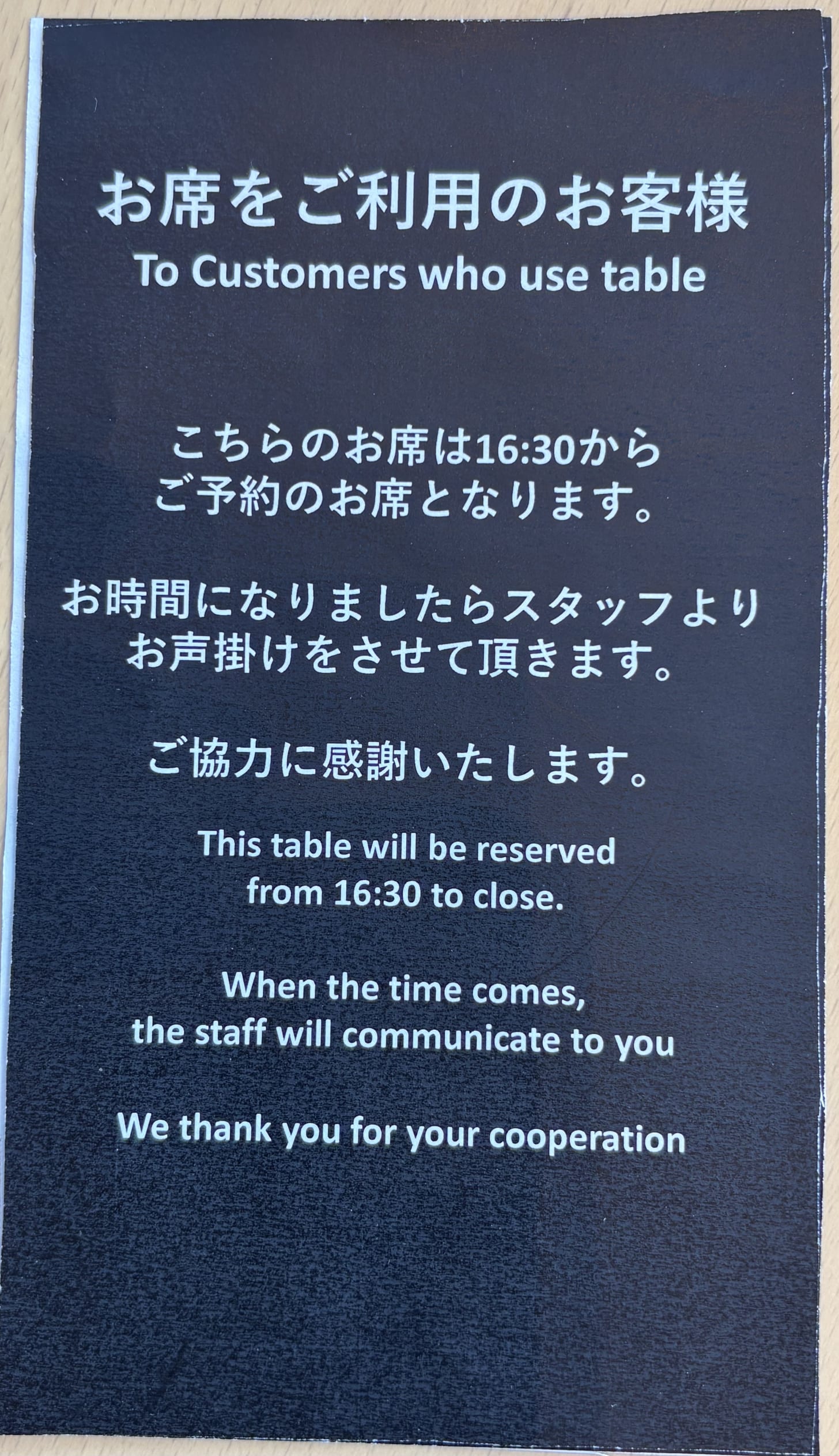
 

A second example of understanding non-standard English. Here are four sentences, each of which has an “error” to decode. It is easy, and shows the vast knowledge of language we all possess as native English speakers.

Let’s review each sentence to contrast my English with theirs.

“To Customers who use table”

OK, I don’t capitalize ‘Customers.’ Not ‘table’, but ‘this table.’ This sentence introduces the next ones, so perhaps a colon would help ‘:’?

“This table will be reserved from 16:30 to close.”

I would change ‘to’ to ‘until.’ Why? I don’t know, but I prefer ‘until’ with time-based (temporal) references of end points in durations. Maybe ‘we close’ is clearer than ‘close’ alone. “… from 16:30 until we close.”

“When the time comes, the staff will communicate to you”

Hhhmmm. A tough one as I wouldn’t be so direct. Perhaps, “We will remind you if you are still here after 16:30.” (I like each sentence to end with a period) There is no need to say that staff will ‘talk to’ (communicate WITH) us.

“We thank you for your cooperation”

Add a period! OK, that’s just my preference. This is a polite way of telling us what to do. “You have been warned” is more direct, but disrespectful to customers. It uses the ‘assumptive close’ since many people may not cooperate! But we can embed a false statement “your cooperation” inside such gratitude: “We thank you for…”

Conclusion

Language is an extremely precise and accurate tool of communication. As an infinite use of composable words and phrases in context, we can understand far more than is written to convey requests.

Understanding isn’t just memorization. The examples show words and phrases that I have never seen!

In this example, perfectly understandable English is being created by native Japanese speakers in a Starbucks shop in Tokyo. While I can write essays on the differences, the purpose of communications is to get our point across in a concise way. This fundamental approach to communications (refer to Grice’s Maxims for more detail) is a standard human model that we are never taught directly, but we seem to follow anyway.

For those who are hoping, sometimes called ‘hopium’, that statistical AI will ‘one day’ be able to understand the myriad of points I have made today, perhaps this essay persuades you to look beyond today’s AI approach. Because the Next Generation of AI is emerging from the cognitive sciences!


 

A view over Tokyo from the top floor of the amazing Starbucks!


Where am I again? Is this a coffee shop, a bar or a museum?!

Do you want to get more involved?

If you want to get involved with our upcoming project to enable a gamified language-learning system, the site to track progress is here (click). You can keep informed by adding your email to the contact list on that site.

 

John Ball inside AI is a reader-supported publication. To receive new posts and support my work, consider becoming a free or paid subscriber.


Similar Posts

  • |

    AI Improves with Cognitive Science Pt 2

    How our brain is put together has been known for some time, but how the brain works remains the final frontier in science. Patom theory changes that. Photo by The New York Public Library on Unsplash Today’s article continues with the analysis of how our brain works. It continues the last article showing what our brain does. Its purpose is to persuade you that the cognitive science behind Patom theory (PT) is the best and only brain model yet. It also explains PT to understand a model of human language in an upcoming article. How brains work There are three sections in this article to make the case: 3.   Pattern-Atoms (The Patom Brain Model) Given what we see happens to our brain from damage and…

  • |

    A Thought Experiment to Improve AI

    Why aren’t artificial neural network systems replacing people? In AI, machines should replicate what we do, not perform statistical calculations. What can we do with a thought experiment to improve our AI? Photo by Kazi Mizan on Unsplash Progress in AI and AGI has had slow enterprise adoption because today’s generative AI don’t work as predicted by big tech CEOs. We’re told fantasy stories about how all of science will soon be solved by machines that gather the statistics from existing scientific papers. But if the scientific papers included the answers to future science, what benefit do we get from AI, since the science is already written? AI today is obviously missing the key piece – how the world works in all its multisensory glory…

  • |

    5 Principles of Accelerated Language Acquisition

    Most language courses start with a textbook, a vocabulary list, and a grammar table. They’re built around what’s easy to teach, not around how the brain actually learns. After more than forty years of working at the intersection of psychology, linguistics, and learning design — and after learning Mandarin Chinese myself in six months — I’ve identified five principles that underlie rapid language acquisition. These aren’t tips or tricks. They’re the foundations. Get these right, and everything else accelerates. Get them wrong, and no amount of study hours will save you. I laid these out in my TEDx talk, “How to Learn Any Language in 6 Months.” Here, I’ll go deeper into each one, and explain why they matter whether you’re learning Mandarin, Japanese, Spanish,…

  • | | | |

    How Long Does it Take to Learn Mandarin?  

    If you’re wondering how long it would take to learn Mandarin Chinese, the answer of course has to be: “it depends”. People usually ask it a different way — is Mandarin hard to learn? — and the honest answer is that it’s different, not hard. If you make a decision to use your brain and your time in the correct way, and put in adequate time, then you could be communicating competently at a basic level within a few months. In other words, the time to learn Mandarin depends far more on your method than on the language itself. You Can Learn To Speak Mandarin in Six Months If you want a rough learn Mandarin timeline, think in months, not years. For me personally, from…

  • | | |

    How To Learn Any Language in Six Months

    How to Learn Any Language in Six Months – Transcript. Welcome to the Transcript page for How to Learn Any Language in Six Months. To find out how these ideas are made real, view the new Speech Genie demo course! Content reproduced here with permission. Read on!  Or scroll to the bottom for the pdf download link. Have you ever held a question in mind for so long that it becomes part of how you think? Maybe even part of who you are as a person? Well I’ve had a question in my mind for many, many years and that is: how can you speed up learning? Now, this is an interesting question because if you speed up learning you can spend less time at…

  • | |

    Upcoming Book: Modern Cognitive AI

    How to build AI that’s like us and its benefit to society! Language, like our ability to navigate the world with our senses and muscles, comes from our brain. AGI needs better ‘cognitive AI.’ We choose our words carefully, because amazing precision is what our brain does. Photo by Brett Jordan on Unsplash I’m writing a new book explaining how AGI works with cognitive AI. I will publish the sections for comment before the final book is compiled. You’ll be able to follow in LinkedIn, Speech Genie, Substack and Medium for the series. I invite you to debate and correct me where you disagree with the model. I want to shine the torch on much-needed science, so let’s do some science! My goal is to…

Leave a Reply

Your email address will not be published. Required fields are marked *