

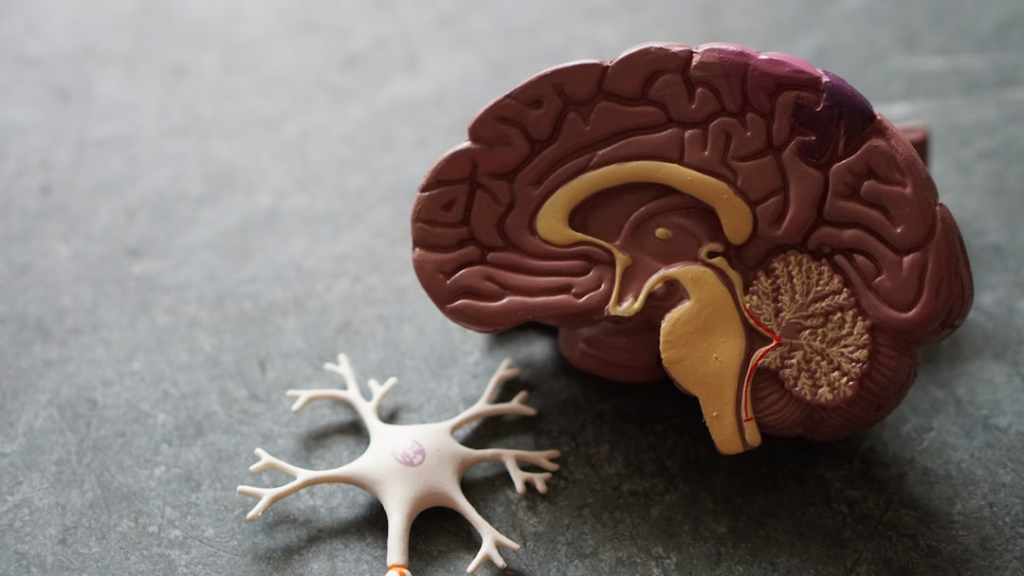
Our brain represents the final frontier in science. Is it a computer, or something else? (Hint: it’s not a computer) Photo by Robina Weermeijer on Unsplash
Today’s article overviews how our brain works.
Its purpose is to persuade you that the cognitive science behind Patom theory (PT) is the best and only brain model yet. It also explains PT to understand a model of human language in an upcoming article.
A thought experiment today illustrates how our brain works as input to the science of PT.
If I say: “Your mother’s face” many of you will have a good idea of what her face looks like. You can choose anyone’s face to do this experiment, and you can choose any modality, too, like hearing, touch, or smell. “Your mother’s voice” supports the same experiment. Evidence of what our brain does comes from the neuroscience of brain damage and scans. It makes a strong point: a human brain’s capabilities enable our best talents. Human languages extend them.
Explaining how our slow brain outperforms super computers in AI with accuracy and speed follows directly from brain science. With new theory comes new opportunities to explain otherwise inexplicable observations to move science forward.
How brains work
There are three sections below to make the case:
1. What we know our brain does (cognitive science)
2. A thought experiment to demonstrate additional brain capability
3. Inferring the pattern-atom model (Patom) from this evidence. PT combines what we know from the first two points.
1. What a brain does
Cognitive science combines a number of disciplines that deal with key aspects of our brain’s function, including neuroscience, psychology, philosophy, computer science, linguistics and anthropology.
Let’s set the scene by using them to establish what our brain does and with science, how it does it. Let’s go through these points in sequence:
A. Brains evolved. The journey to the human brain over the last 500 million years is instructive as changes typically incorporate successful functions.
B. In brains, regions emerge that perform specific functions.
C. The regions are not fixed and can be located in different places in different people limited mainly by connectivity.
D. Our analysis can make use of our subjective experience if we can bypass the behaviorism limitations.
E. The philosopher, David Hume, observed the difference between impressions and ideas in the 1700s that we can use in our model.
A. Evolution is Instructive
The human brain develops with a standard anatomy, but just as an individual’s hands have different finger dimensions, and their height and weight differs, so too their brain varies from others.
Our brain evolved from simpler ones with long-tested, effective survival benefits. That’s because all animals follow the principles of evolution and our brain had some amazing foundations to build on. Much of the earlier brain remains with extensions for additional benefits.
The earliest parts of our brain are ancient. Our brain stem gives us breathing, body temperature and a sense of awareness that makes our body a system to be protected.
Our brain accepts sensory inputs from specialized neurons in our sensors (e.g. nose, eyes and ears) and produces motion using muscles. The network of useful sensors around our body enables vision, hearing, balance, temperature, pressure, pain and more. Earlier animal like fish, from our evolutionary past, have similar systems.
On top of this, more complex animal brains began to incorporate other functions and enlarge the neocortex. The neocortex is able to perform a range of functions—from improved vision to improved sound recognition—in fact, key building blocks for human language.
Language evolved as a small step on top of the brains of other animals and is enabled by our innate ability to recognize objects in the world, their properties and related states and activities in context. Then, by labelling these objects in a consistent way, our brain communicates! Our large frontal and temporal lobes, when compared to other animal’s brains, are central to this ability, but more on language in a future article.
Many animals share the earlier brain regions, so today’s focus will be on the new regions and especially those that only human beings have in scale.
B. Brain Regions (from brain damage effects)
Some quick background is helpful here to see that brains have localized regions.
Broca’s Region (Speech – muscle motion control)
In 1861 Paul Broca studied a patient who couldn’t speak. It turned out the patient had localized brain damage to a region in his left frontal lobe. Broca continued to study this phenomenon to confirm the function of that region.
Wernicke’s Region (Language Comprehension)
After Broca’s work, in 1873, another medical pioneer, Carl Wernicke, found a localized region in the left temporal lobe caused the loss of language comprehension. Interestingly it did not affect speech production. Speech was fluent, but nonsensical.
Reading and listening recognition itself are unchanged with this condition because those functions come from different regions in the temporal lobe (vision and hearing, respectively), but the brain cannot identify its meaning with Wernicke’s aphasia.
C. Brain Plasticity
A key, perhaps baffling, feature of a brain is its plasticity. Regions can enlarge through use, be located in different places in different people and even be replaced following damage in some cases.
For medical procedures on your brain, the surgeons will often have part of the work done with ‘awake brain surgery’ in which the patient is able to respond to preserve essential brain functions such as speech, movement and sensation by testing brain tissue function in real time. A local anesthetic is used to limit the patient’s pain as the brain itself has no pain receptors. Because our brains are all different, the particular regions near damage can be checked prior to removal to maximize the success of the procedure without causing additional, unexpected damage.
In the case of human brains in particular, our cortex develops regions for each sense. Presumably due to the slightly inaccurate innate connections from our senses to our brains, the same functions can develop in different regions of the brain. Some regions even tend to be specialized in a particular hemisphere, but there is always possible variation.
In the case of vision, there are a range of regions that are involved for specific visual functions. I will focus on facial recognition later. Other regions enable color perception and the recognition of visual movement. Our brain also has regions that recognize whole objects, and the reverse, the recognition of the parts of whole objects. Object recognition is very fast as we recognize many objects at a glance.
As discussed, there are brain regions for speech production and language comprehension. In addition, visual word recognition is separate from auditory word recognition. There is also a long list of other specialized regions both within senses and between combinations of senses.
Again, due to plasticity, regions in each person’s brain, like those that perform visual color recognition, emerge in different locations in different people. Plasticity is a key hint to brain function that must be explained.
D. Philosophy of Behaviorism
I’ve found behaviorism a problem in cognitive science. Can you use your own memory and experience to describe how a brain works? It became a form of self-censorship.
In the early 1900s, the concept of behaviorism became popular, especially in the US. It said that science could not refer to mental models as that would be unscientific! The focus was on behavior that could be seen and measured, as a reaction to forms of psychology that didn’t have predictive capability. Reactions to stimulus was preferred to subjective experience.
Up until recently, I also followed this approach in my scientific writing.
But science progresses past such models, when necessary for progress. And it is necessary now.
John Searle, the late philosopher from UC Berkeley, wrote a great solution to the behaviorist problem of ‘mental states:’
“In ‘cognitive sciences’ one presupposes the reality and knowability of the mental in the same way that in physical sciences one has to presuppose the reality and knowability of physical objects.”
The alignment of physical objects is explored in the movie, ‘The Matrix,’ where people’s reality is imagined to be a simulated construct. Also, reinforcing the behaviorist model is my hero, Alan Turing with his imitation game. Searle commented further with this:
“The Turing test is typical of the tradition in being unashamedly behavioristic and operationalistic, and I believe that if AI workers totally repudiated behaviorism and operationalism much of the confusion between simulation and duplication would be eliminated.”
This distinction between simulation and duplication is often raised in modern, online AI.
E. Hume’s Ideas and Impressions
The Scottish philosopher, David Hume, made a distinction between impressions, what your senses are receiving at a moment in time, and ideas, the recall of those stored impressions. Impressions are strong and powerful experiences, while ideas are fainter versions from memory.
Ideas have the additional property of allowing combination. This allows flexibility in imagination, such as for winged horses and flying pink elephants. With the potential for ideas to be false, Hume called for a reliance on impressions only for accuracy.
2. Thought Experiment (what can our brain do?)
Now that we have a starting point for what our brain is shown to do, we can look in detail at the capabilities we all share with a thought experiment. The thought experiment can use our ‘internal voice’ because the behaviorist model is excluded.
A Deep Dive into our Brain
Your world experience is typically an interaction between you and objects. Your brain recognizes those objects and manipulates them in context under your control. That’s what brains do!
But that’s not how brains work in detail as discussed above. Rather than our brain’s conscious view of the world, brain regions perform specific functions such as comprehending language and generating it. Even memories of events require a specific region in our brain to function in order for them to be laid down.
Our brain’s experience of the world is oblivious to that detail, unless the region is damaged or connections to it or from it are broken.
Sense
Let’s get back to the thought experiment. Think of your mother or someone else you know well.
Your brain must recall the idea of your mother at this point, a memory of the sum of your impressions of her in the past. The impressions no longer exist, of course, since impressions are only fleeting.
Now imagine their face. Can you almost picture it? Their eyes? How their hair looks, perhaps not covering their ears? If you can, that’s an idea you are recalling per Hume.
But where is the idea? Is it encoded and centralized, or something else? The location of relevant regions is a role of neuroscience.
Thinking About a Face
So, that idea, your memory of someone’s face, is more faint to recall than a scrapbook of still images or a movie. Brains are primarily recognition systems, with recall being far less capable along the lines of the impression/idea distinction.
Interestingly, the experiment’s result demonstrates that two different regions were automatically connected! One region stores the idea of your mother, and another one stores the idea of her face. Perhaps via contiguity, the association is nearly perfect, since faces don’t get confused between people you know well.
Notice also that recall need not be one sense alone. It may come from different parts of our sensory regions. Just move from their face to their hair, or their arms, or a tattoo, or their clothing. Our brain has this information without ever training for it. A single experience is sufficient.
In fact, there is a particular part of our brain on the ‘underside’ of our temporal lobes that provides the function of facial recognition. The damage to this general region was the inspiration for the 1985 Oliver Sacks’ book, “The Man Who Mistook His Wife for a Hat and Other Clincal Tales.” That patient had visual agnosia that disabled recognition of faces and objects, too.
The effects of that kind of brain damage demonstrate the region’s function for facial recognition, and as a result, people must identify others with different means – such as by their clothes, perfume or voice.
The fact that you still ‘know someone,’ (what they have done, who they are, etc.) but can’t recognize their face, supports the model that at least two regions are involved for normal operation, and one is damaged here.
Our brain’s tracking of ideas is very powerful, as seen with abilities like language to describe the many things going on at a point in time.
Multi-Sense (Combined Patterns)
Did you notice how imagining your mother’s face is an important observation?
Let’s consider what happened.
Naming your mother comes from language. Your brain needed to recognize the word ‘mother’ and the possessive that owns it, ‘you’. This comes from our auditory cortex when spoken and our temporal lobe in a region known as the letterbox, next to the facial recognition region, when reading. Now that you have the word, it connects to comprehension in the Wernicke region of the temporal lobe.
In the next section, we’ll develop the science to explain what regions do.
A key thing to notice is how precise the connections are between these different regions.
When you think of your mother and recall her face, it isn’t luck that it is her face. The patterns between senses are retained. I think of object recognition as combining each sense for an object, as in this case. An object includes what it looks like, how it sounds, what it feels like, smells like and so on.
These are multi-sensory patterns, objectively made from a combination of regions.
More Dimensions
Now can you recall where you most recently saw your mother? If so, you are recalling that idea from a different region. What about her perfume? That is also a different region. Where was the best food she ever made for you? If you can imagine its taste and aroma, your brain is recalling from two additional regions
Next Time
In Part 2, coming up shortly, I will go through this information as a starting point to find a model that explains what we observe. Why isn’t a brain a computer? That’s a consequence of what we can see. Why does PT talk about hierarchical, bidirectional patterns? It’s because the observations, when followed, lead to it.