
If you’re looking for a Duolingo alternative for Chinese, you’ve probably already felt the thing that sends most people searching: the streak is long, the owl is happy, and you still can’t say much. So let me answer the real questions honestly — is Duolingo good for Chinese, where exactly does it leave you stranded, and which of the alternatives actually fixes that. I’ll be fair to all of them, including Duolingo, because the goal here isn’t to bash an app — it’s to match you with the thing that gets you speaking.
Is Duolingo Good for Chinese? The Honest Verdict
Duolingo is a genuinely good piece of software, and it does several things well. It’s free, it’s beautifully made, and its real masterstroke is motivation: the streaks, the reminders, the little wins which keep you coming back. Showing up daily is more than half the battle. For an absolute beginner it’s a gentle, low-pressure on-ramp — you’ll pick up pinyin, start recognising characters, and build a base of common words and simple sentences. The Chinese course also got real upgrades in 2024, with better pinyin integration and phonetic-based grading that addressed some of its oldest pronunciation complaints.
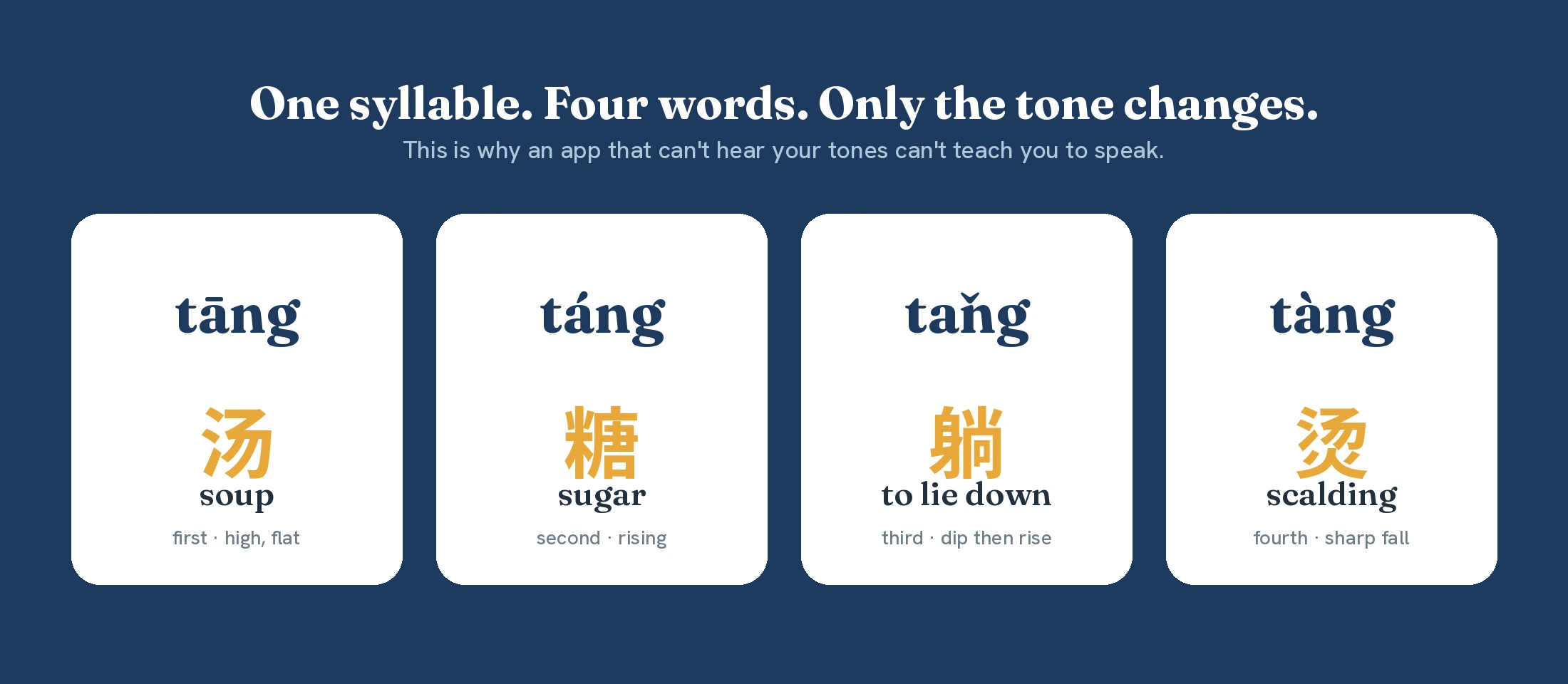
Now the honest part. Duolingo gets you to roughly HSK 1–2 — a late-beginner reading level — and then it stalls, hard, on the things that actually make you a Chinese speaker. Take tones. Duolingo can’t really hear yours, so it can’t correct them, and tone errors quietly fossilise. In fairness, no software can truly hear your tones and pronunciation the way a human can — that isn’t a failing unique to Duolingo. But the fix for that problem isn’t a cleverer grading algorithm. It’s training your own hearing, so that you can actually correct your own pronunciation. An app that simply waves your tones through, with no work on your ear, just leaves you certifying your own mistakes. And in Chinese the stakes are real:
tāng (soup), táng (sugar), tǎng (to lie down) and tàng (scalding) are four different words — separated by nothing but tone. You can hear the four tones for yourself here.
What about grammar? Duolingo explains almost none — you match sentences without being told how they’re built. I want to be clear that this, on its own, is not the flaw people assume it is. Drowning beginners in grammar rules is the old, broken way of teaching; moving away from conscious grammar analysis is actually the right direction, and to Duolingo’s credit it doesn’t bury you in it.
The real problem sits elsewhere. Importantly, Duolingo leans heavily on translation drills — turning English into Chinese and back — which trains you to think in English rather than building the skill that matters: connecting what you think directly with the Chinese coming out of your mouth. That’s why everyone describes the same experience: you finish a unit, you’ve “learned” dozens of sentences, and you’re still speechless in your first real conversation. So — can you learn Chinese with Duolingo? Up to a point: a base, a habit, a start. Not a speaker.
I’d add one more thing worth knowing in 2026. In 2025 Duolingo announced it was going “AI-first,” phasing out human contractors for content that AI could handle and openly accepting occasional small dips in quality for the sake of speed; it rolled out 148 AI-built courses in one wave. Plenty of users and language professionals pushed back, reporting clumsier translations and a more machine-made feel. None of that makes Duolingo useless. But it strongly suggests the focus there is more on looks than on substance that can help you get to fluency.
My verdict, in one line: Duolingo is a brilliant on-ramp and a poor road — worth a month of your time to kill the fear and build the habit, but it can’t give you the three things that actually make you into a speaker. A tool optimised to scale content and keep you engaged is not the same as a method designed to make you fluent.
Why Drill Apps Plateau
The plateau isn’t bad luck — it’s built into the format. Gamified vocabulary drills are good at one job: getting you to do another lesson. And gamification itself isn’t the villain; done right, it’s just motivation, and motivation is precious.
The problem is when the game becomes an end in itself — an engagement loop engineered to keep you tapping, racking up streaks and points, while the actual acquisition isn’t happening underneath. If the loop is driving activity but not driving real skill, you can pour in months and end up with a trophy cabinet and a silent mouth.
I’m not speaking in the abstract here. I personally know several people with Duolingo streaks of more than four years who still can’t say much at all — and are certainly nowhere near fluent. Four years of daily activity, and a silent mouth. That’s the engagement loop doing its job while acquisition never happens. Let’s be clear — engagement alone does not create a fluent speaker.
Most drill apps also teach you about the language — facts, words, matching exercises — rather than building the skill of using it. Knowing things about Chinese and being able to speak Chinese are different achievements, and only one of them is the point.
What to Look For in an Alternative
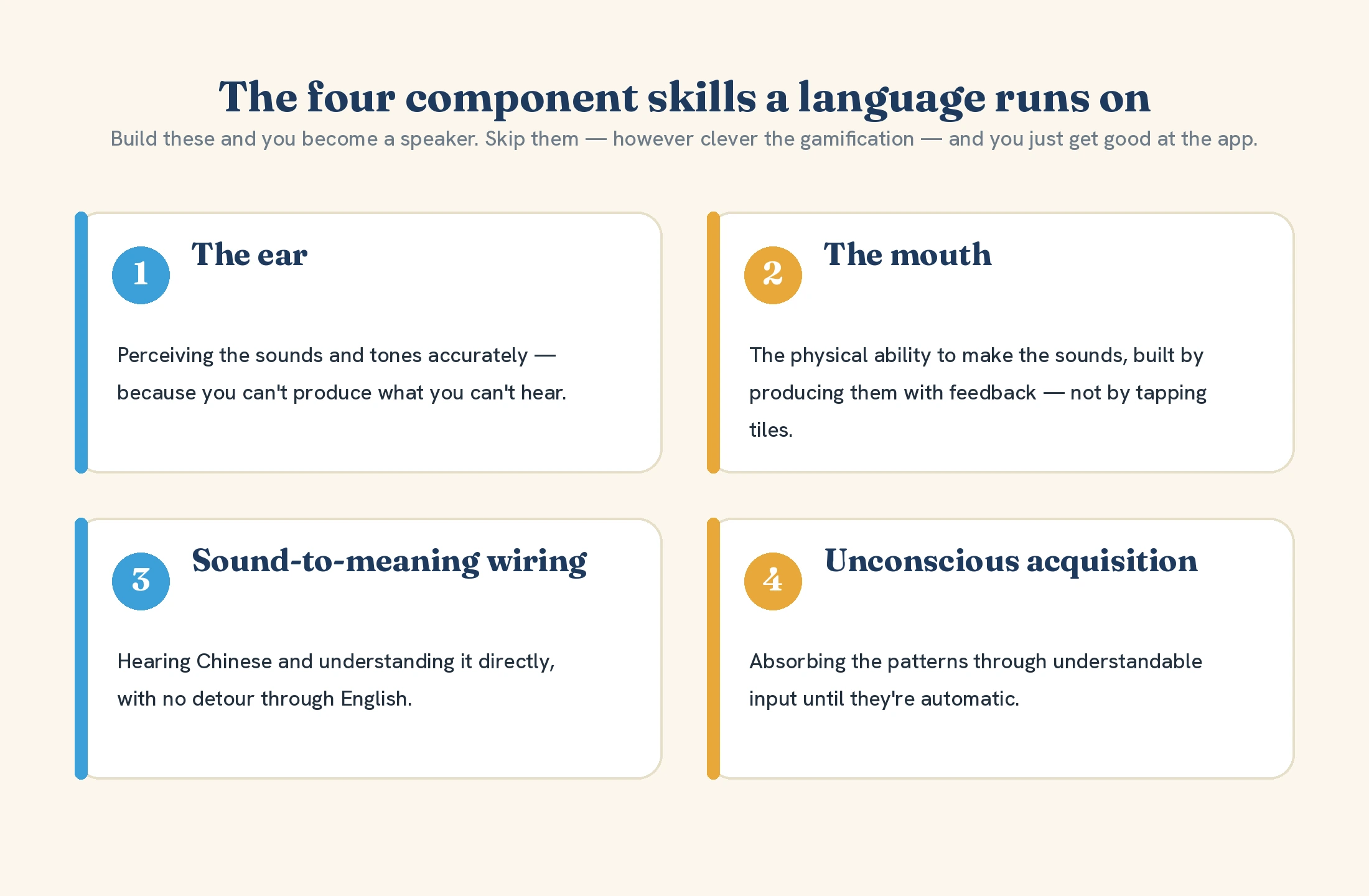
Forget feature lists for a second. The right question is whether a tool builds the component skills a language actually runs on. There are four — and each maps onto something concrete you can look for:
- The ear — perceiving the sounds and tones accurately, because you can’t produce what you can’t hear. This is what relaxed, low-effort listening builds — what I call brainsoaking — through input you don’t even try to understand. You simply listen to the speech the way you listen to birdsong in the morning.
- The mouth — the physical ability to make those sounds, built by producing them with feedback, not by tapping tiles. The fastest way in is to watch a native speaker’s face and copy the movement — what I call FaceFonics® — so your muscles learn the shape of the sound.
- Sound-to-meaning wiring — hearing Chinese and understanding it directly, with no detour through English. You build it by responding to what you hear with your body — Language to Body — so the sound connects straight to meaning, with no mother tongue in the middle.
- Unconscious acquisition — absorbing the patterns through understandable input until they’re automatic, in the order the brain actually wants them (understanding, then sound, then meaningful speech — the developmental sequence), instead of memorising rules you then have to consciously apply.
An app that develops these skills will make you a speaker. And, let’s be clear: language is a set of interlocking skills, not a library of knowledge. An app that skips any one of the core skills — however clever the gamification — will make you good at the app. The language? Not so much. That’s the lens I’d judge every option through, including mine.
Head-to-Head: the Main Alternatives
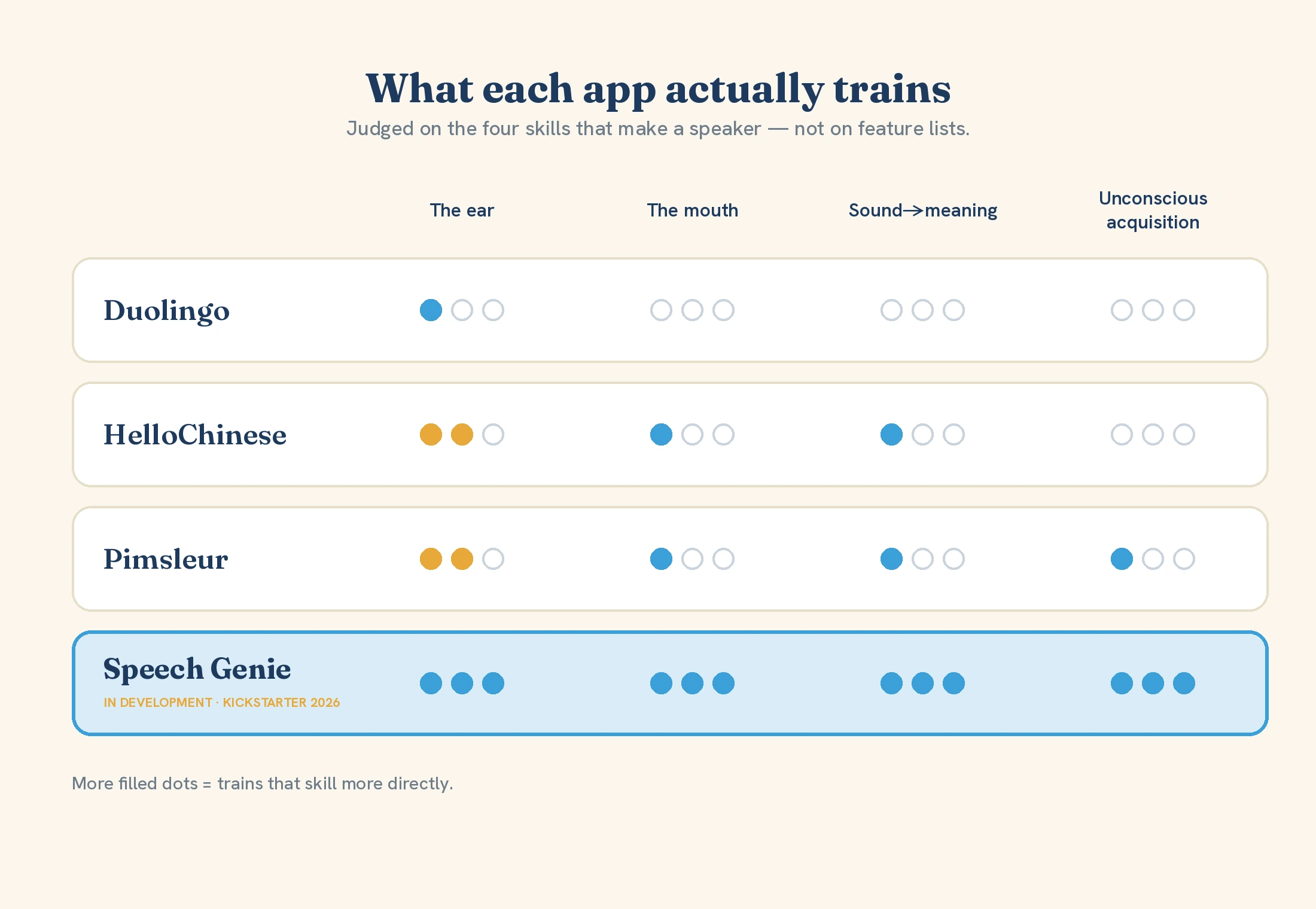
Here’s how the field actually stacks up for Chinese. Most Chinese learning app reviews hand you a ranking; I’d rather hand you the honest one-paragraph version of each, judged on those four skills. Each earns a fuller review of its own, linked as those go live.
- HelloChinese — the closest thing to “Duolingo done right for Chinese.” In any HelloChinese vs Duolingo comparison it wins on substance: same friendly, gamified feel, but HSK-aligned, with explicit tone training and visual feedback, real grammar explanations, character and stroke-order practice, and graded readers. Generous free tier; premium runs around $12 a month. The best structured-app starting point — though it’s still an app, so it won’t give you genuine conversation.
- Pimsleur — the most interesting of the lot, because it got a real piece of the pedagogy right. In any honest Pimsleur Chinese review, you start with respect: it’s audio-only, thirty minutes a day, and it understood two things most apps miss — listening comes first, and you build up in steadily increasing complexity. What it misses is just as telling: there’s no multi-sensory dimension, the physiological training of the mouth is shallow, and there’s little of the unconscious, meaning-driven acquisition that makes language stick. It builds confident travel phrases; it doesn’t build a full speaker. It’s also pricey (around $20 a month) and teaches little reading or writing.
- LingoDeer — grammar-first, and unusually good at it, because it was built by teachers and linguists specifically for Asian languages. Clear explanations, sentence-based lessons, native audio, stories. Stronger than Duolingo on understanding how Chinese works; weaker on real speaking and pronunciation feedback.
- Du Chinese — not a course but a superb reading companion: graded stories with audio, tap-for-dictionary, natural translations. Brilliant for building the ear and reading once you have a foothold — but it doesn’t solve the problem that most people fail before they ever get that foothold.
- ChinesePod — a vast library of conversation-based audio and video lessons with transcripts and notes, great for listening on the go. Powerful but unstructured — you supply the discipline and the sequence. (Dig through their archives and you’ll probably find a Mandarin interview the founder, Ken Carroll, did with me back in the early 2000s.)
- Busuu — polished, with a nice feature where native speakers correct your exercises. Useful for that feedback, but the Chinese course is thinner and less accurate than its big European ones.
- Super Chinese — AI-driven and speaking-forward, leaning into conversation practice earlier than most. A promising direction — with one important caveat. You should never push yourself to speak before you understand what you hear well enough to feel a genuine urge to speak; and by “well enough” I mean you hear it and know what it means without any mental translation. Speaking forced ahead of comprehension just drills anxiety. Speaking that follows understanding is the real thing. The one exception is what I call your survival toolbox — a small set of fixed, high-value phrases (hello, thank you, how much, I don’t understand) you do learn upfront, simply to get by while the real acquisition catches up.
- Mango Languages — practical, conversation-first, and often free through your public library — which makes it genuinely worth checking. Good for travel-ready phrases; light on depth and on character work.
Where Speech Genie Fits
So where does the Speech Genie system sit in all this? Honestly: Speech Genie isn’t trying to be a better flashcard game. It’s being built to match the needs of the brain as it learns a language — to train the ear and the mouth, wire sound directly to meaning, and drive unconscious acquisition through input you can actually use, in the order the brain wants it.
Here’s what should reassure you: this isn’t theory, and it isn’t a prototype. The technology is already proven and in market — it’s the engine behind Kungfu English, which has helped Chinese speakers learn English for years. Brainsoaking, Language to Body, FaceFonics®, self-recording and feedback all work, today, in a real product. That’s the gap every app on this list leaves open to some degree: they teach you about Chinese, drill your vocabulary, or build your ear — but none of them puts the whole machine together to get your mouth moving from the start.
Speech Genie takes that same proven technology and builds it for Mandarin and English learning, with the course redesigned around PatAI. A full demo is ready now — you’ll find it just below. What we’re building, and raising funding for, is the complete course with PatAI woven through it: a cognitive AI, built on John Ball’s Patom Theory, that turns the experience into true two-way interaction — a digital language parent that understands what you actually mean and responds, the way a patient native speaker would. If Duolingo is where you started and speaking is where you’re stuck, that’s exactly the gap Speech Genie is being built to close.
The fastest way to feel the difference is to try it, not read about it. The demo runs right in your browser — your first two lessons are free, no sign-up — and lets you experience the method first-hand: brainsoaking, Language to Body and FaceFonics®. Try the demo →
Short on time? Try a single L2B lesson →
About the author
Chris Lonsdale (龍飛虎) is a psychologist, linguist and educator who reached fluency in Mandarin as an adult in six months, got to native level in less than two years, and learned Cantonese in four months. He developed Language to Body, a digital evolution of Total Physical Response, and created the Kungfu English learning system, the proven, in-market technology that underpins Speech Genie. His TEDx talk, “How to Learn Any Language in Six Months,” has been watched more than 37 million times. More at chrislonsdale.com.