
How long it takes to learn a language comes down to three things: how close it is to a language you already speak, how many hours you put in, and — most of all — your method. By the traditional translate-and-memorise approach, most adults need one to two years to hold a real conversation in an easier language. And that number is only for the very small percentage of people who push through the extreme difficulty of that 240-year-old approach. With a brain-based, meaning-first method, conversational fluency becomes a realistic six-month goal.
The short answer: it depends on three things
The honest answer to “how long” is “it depends” — but it depends on knowable things, not luck. The first is overlap: a language close to one you already speak (Spanish for an English speaker, say) takes less time than a distant one. The second is hours: an hour a day and an hour a week produce very different timelines. The third, and the one almost everyone underestimates, is method — because the wrong method can multiply the hours required several times over.
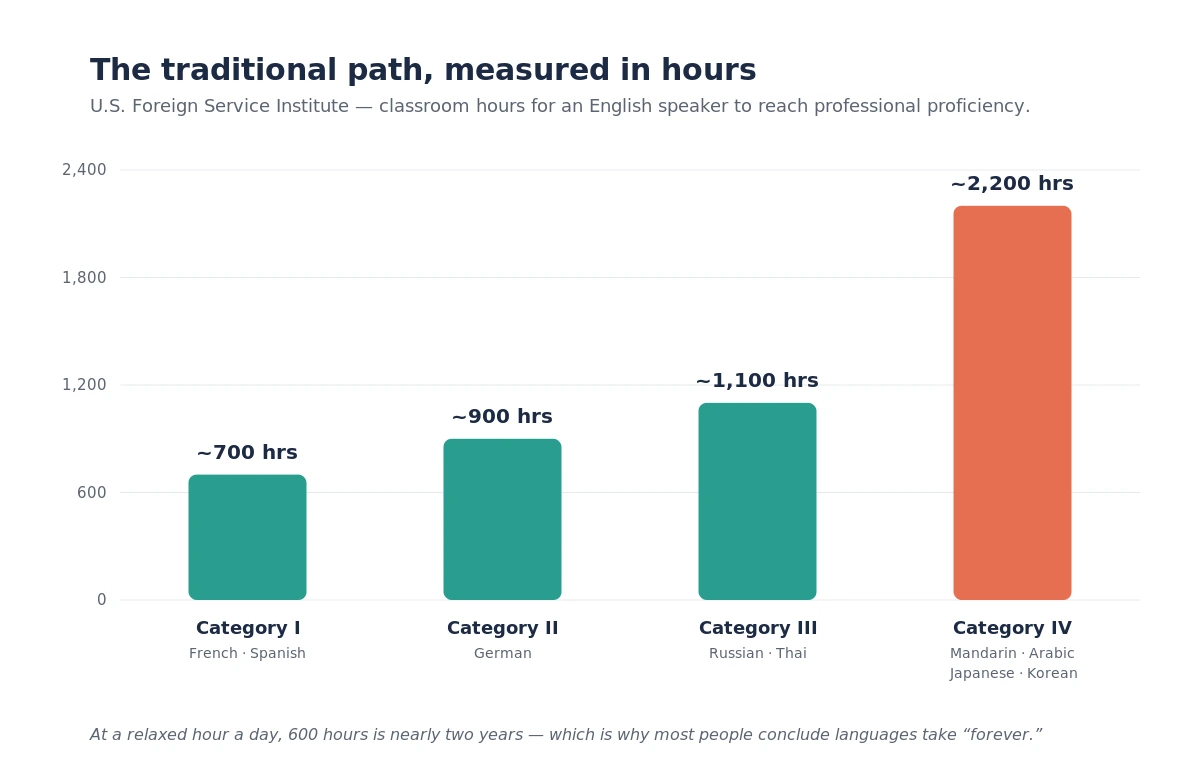
The usual benchmark people quote comes from the U.S. Foreign Service Institute, which tracks how long its diplomats take to reach professional working proficiency. Its easiest languages take an English speaker roughly 600–750 hours; its hardest — Mandarin, Arabic, Japanese, Korean — around 2,200. Those are real numbers, but notice what they measure: hours spent in a traditional classroom, aiming at a high professional bar. At a relaxed hour a day, 600 hours is nearly two years — which is exactly why most people conclude languages take “forever.”
How long does it take to become fluent in a language?
First, let’s decide what “fluent” actually means. “Fluent” does not mean “perfect” or “native.” Conversational fluency means you can hold a real, comfortable conversation — follow what is said, respond without freezing, get your meaning across. That arrives well before the professional proficiency the FSI hours aim at, and long before the polish of a native speaker (which, remember, keeps improving all the way into your later years even in your first language).
Held to that practical standard — comfortably conversational — a realistic target is around six months for most languages, provided you are learning the way the brain actually acquires language. Native-level mastery is a longer road, but you do not need to wait for that achievement before you start living in the language. You become useful in it far sooner than the big hour-counts suggest.
More importantly, you cannot achieve native-level mastery unless you are using your new language in real life on a regular and consistent basis. Getting to basic fluency is the first step in that journey, and that first step is nowhere near as hard as you may have believed.
Why the same language takes one person six months and another six years
Here is the part the timelines hide: the biggest variable is not the language. It is the method. Two people can study the same language for the same hours and finish miles apart, because most courses spend those hours inefficiently — translating, memorising word lists, drilling grammar rules. Every hour spent translating in your head is an hour not spent wiring the language directly to meaning. The translation habit is the bottleneck, and it is there in every language.
Remove it — learn meaning-first, the way a child does, with sound connected straight to experience — and each hour starts to count for far more. That is how the timeline compresses from years to months. The clearest proof is personal: I created the Kungfu English learning system that Speech Genie is built on, and as an adult I reached native-level Mandarin and learned Cantonese — two of the languages the difficulty charts call the hardest on earth — in a matter of months. My TEDx talk on exactly this, “How to Learn Any Language in Six Months,” has been watched more than 37 million times. Six months is not a slogan; it is what happens when you stop wasting valuable time on an approach that really does not work for the vast majority of people.
How long does it take to learn English?
English sits in the middle of the difficulty range. For speakers of European languages the vocabulary overlap is large, but the spelling and pronunciation are famously irregular, which is where the traditional method bogs learners down — years of study and a stubborn plateau where they can read and pass tests but still freeze in conversation. When you learn through pattern recognition and meaning first, with all of your senses engaged, English follows the same rule as everything else: comfortable, conversational English in around six months, because the method spends every hour on understanding and only then speaking rather than on rules about a language you cannot yet use.
A realistic timeline — and how to hit six months
The math is friendlier than it looks once the hours stop being wasted, and a handful of concrete daily actions keeps you on track. Consistency beats intensity: a focused stretch every day moves you faster than an occasional marathon, because the brain consolidates patterns through regular exposure, not cramming.
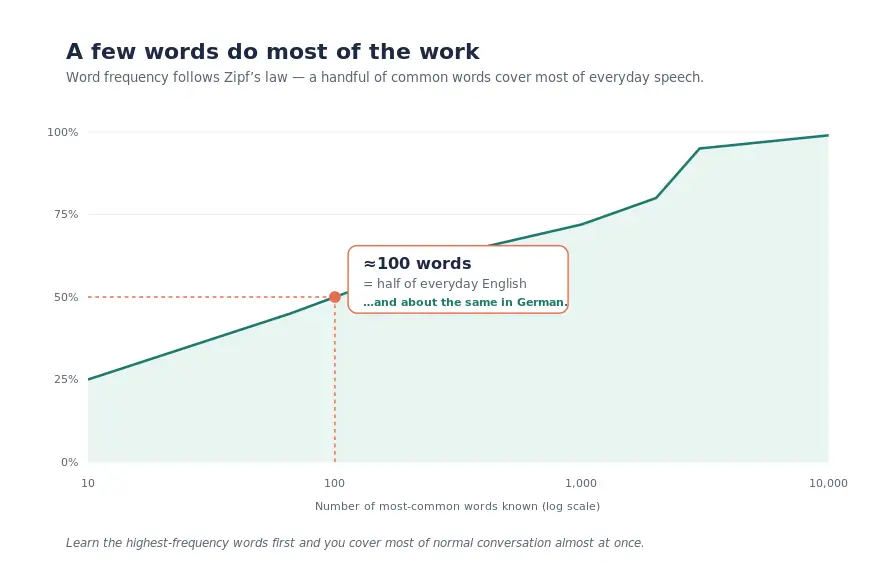
And you reach useful milestones early, because a surprisingly small core of words does most of the work. That isn’t wishful thinking — it’s a measurable property of every language, known as Zipf’s law: a few words come up constantly while the rest tail off fast. The 100 or so most common words make up about half of everyday English — a property of the billion-word Oxford English Corpus — and about the same in German. Your target language follows the same pattern, so if you learn the highest-frequency words first you cover a large share of normal conversation almost at once. Vocabulary researchers have put hard numbers on it: the most frequent 2,000 word families alone account for around 80% of ordinary written text and roughly 95% of everyday speech (Nation & Waring, 1997). Learn those first and you understand most of what you’ll hear long before you’ve learned most of the words. This is exactly why a meaning-first method produces usable speech in the first weeks instead of the first year — your earliest hours go on the words you’ll lean on most, not an alphabetical list that buries them among the rare ones. And those early wins are what carry people through to the six-month mark.
There is a deeper reason consistency works, too: revisiting what you already know is not a detour — it is the mechanism. Every time a word or pattern comes round again, it moves a step closer to automatic. The traditional syllabus assumes the opposite — learn it once, tick the box, move on and never meet it again — and that single assumption is a large part of why so little of it ever sticks.
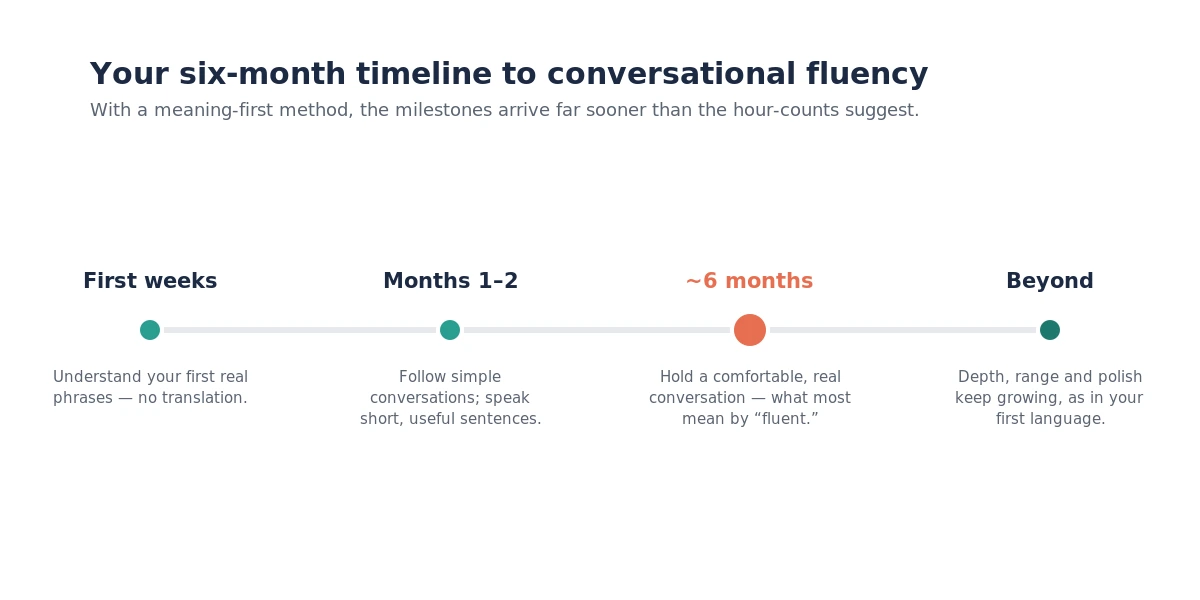
- First weeks: understand your first real phrases — no translation, meaning attached directly to sound and image.
- First couple of months: follow simple conversations and start producing short, useful sentences of your own.
- Around six months: hold a comfortable, real conversation — the point most people mean by “fluent.”
- Beyond: depth, range and polish keep growing for as long as you use the language — exactly as they do in your first one.
That is the whole idea behind Speech Genie, and why I built it: so you can spend every minute the way your brain actually learns. At that point “how long” stops being measured in years. You can try it free — pick English or Mandarin and learn your first real words in your browser, no sign-up. Play a free lesson →
Frequently asked questions
How long does it take to learn a new language?
For most new languages, comfortably conversational in around six months is realistic — whether it’s your second language or your fifth. A new language close to one you already speak lands sooner, a distant one takes a little longer, but your method moves the number far more than either. Learn meaning-first, the way a child does, and six months is a sensible target for a new language.
How many hours a day should you study?
Daily consistency matters more than total volume — 30–60 minutes every day, broken into small chunks of 5–10 minutes, beats three hours once a week, because the brain consolidates patterns through regular exposure. What matters most is that those minutes go on understanding and speaking, not on translating and grammar drills.
Can you actually become fluent in six months?
Yes — if “fluent” means comfortably conversational rather than flawless and native. Six months to real conversation is achievable with a meaning-first method that wastes no time on translation. It is the basis of the most-watched language-learning talk ever recorded.
How long does it take to learn a language on your own?
Self-study can be faster than a classroom, not slower — you set the pace and further strengthen things you can already do. The deciding factor is the method, not whether a teacher is in the room: learn the way a child does and you can reach conversational fluency on your own in around six months.
About the author
Chris Lonsdale (龍飛虎) is a psychologist, linguist and educator who reached native-level Mandarin as an adult in six months and learned Cantonese in four. His TEDx talk, “How to Learn Any Language in Six Months,” has been watched more than 37 million times. He created the Kungfu English learning system and built Speech Genie to put the brain-based method into something anyone can use today. More at chrislonsdale.com.