
The best way to learn a language is the way your brain already learned your first one — meaning first. That means sound is tied straight to experience with no translating in between. Almost every course in the world today teaches the opposite. This is exactly why most people stall, struggle or outright fail.
The short answer
The best method isn’t a particular app or a magic number of minutes a day. It’s an approach to language learning itself. Learn the way a child does — understand meaning directly, soak up the sounds, then speak — rather than translating, memorising lists or drilling grammar. Get the method right and the smaller choices, like which app or how many hours, matter far less than most people will tell you. The caveat, of course, is that once you understand the correct method you’ll be very good at discerning which tools serve you and which do not.
Why most ways to learn a language don’t work
Most language courses and systems cycle through the same handful of approaches, and nearly all of them share one hidden flaw: they keep you translating in your head, rote-learning lists of words, and learning about the language instead of using it.
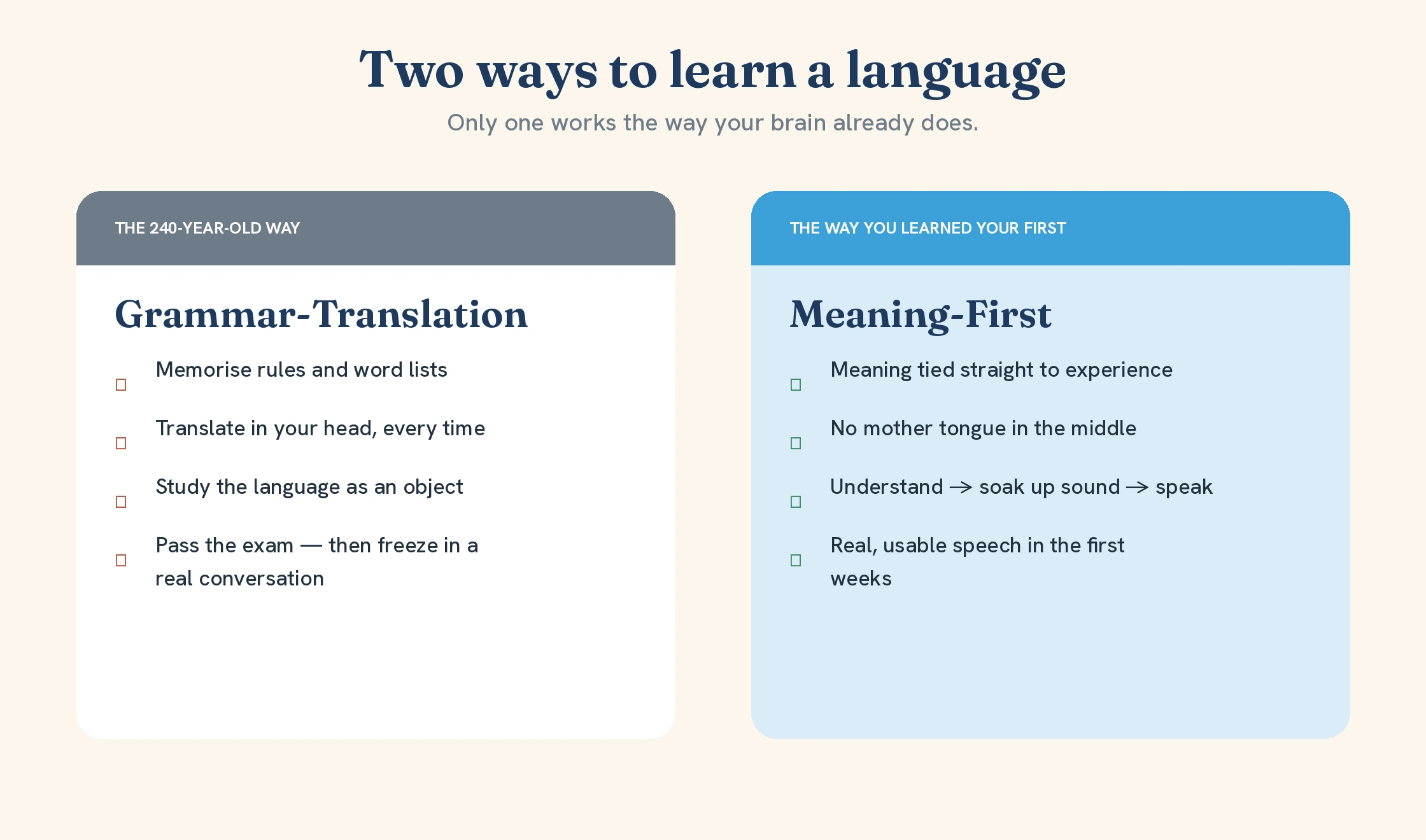
Grammar courses teach the language as a set of rules to memorise. You can pass an exam and still freeze the moment a real conversation starts.
Vocabulary apps turn learning into a game of streaks and word lists. Fewer than one in a hundred users ever finish a course — and finishing still doesn’t mean you can speak.
Memorising word lists gives you words you can recite but can’t reach for in real time.
“Just move to the country” sounds like the answer, but immersion without a method is often months of noise — exposure is not the same as acquisition.
Language-exchange apps and tutors help, but if you can’t yet understand what you hear, you stall.
The thread running through all of them is a 240-year-old model — Grammar-Translation, invented in 1780s Prussia for reading dead languages. It was never designed to make you speak.
None of these options is useless — apps build a daily habit, classes give structure, immersion gives exposure. The problem is what they are all built around: studying the language as an object. You end up with a head full of facts about French and very little ability to speak it. The best way actually flips this order — you build the ability first, and the facts take care of themselves.
What actually works: learn the way you learned your first language
You already did the hardest language-learning of your life before you could read. You didn’t translate, memorise lists or study grammar — you connected sounds to meaning through experience, and the patterns wired themselves in. Your brain is a pattern-matching machine, and the best method works with that instead of against it.

That means meaning first: you understand before you analyse. You hear language tied to something real — a picture, an action, a situation — and the meaning attaches directly, with no mother tongue in the middle. Take out the translation step and the bottleneck that makes every language feel hard simply disappears.
In linguistics the input side of this is called comprehensible input — language you can understand, pitched just above your current level, where the meaning is clear from context rather than from translation. It is how every child gets started, and it is the most reliable engine of language acquisition we know of. Pair it with the other thing children do — copying sounds and speaking words long before they are ‘correct’ — and you have the whole method in three steps: understand, respond without words, then start to produce — beginning with the very simplest language.
It sounds abstract until you remember how it felt the first time. A child hears the word for “hot” the moment they feel the heat of a stove, and the word fuses to the sensation — no definition, no translation, learned once and never forgotten. That is pattern-matching doing what it does best. The best way to learn a second language simply rebuilds those conditions on purpose: meaning you can see or feel, attached to sound, again and again, until it sticks.
The best way, stage by stage
This approach follows the order your brain actually builds a language:
- Soak up the sounds — absorb the rhythm, tones and shapes through relaxed listening, and by watching how native speakers move their mouths, long before you worry about getting anything ‘right.’
- Understand — meaning first, no translation. You hear a phrase and respond to its meaning, pointing, acting or choosing the right picture, so sound wires straight to your senses.
- Speak — produce it yourself, out loud, and be understood; record and compare, the way you trained your own ear as a child.
- Converse — put it all together and hold a real, comfortable conversation.
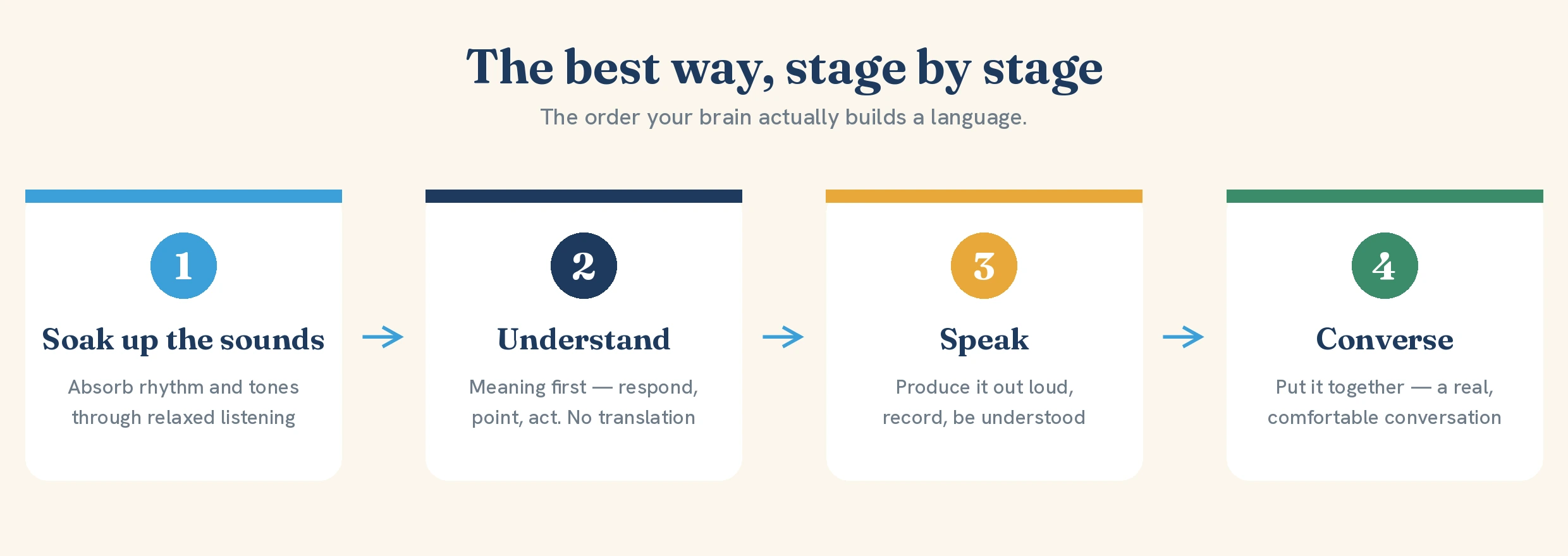
Each stage rests on the one before. And you reach useful milestones early: a surprisingly small core of words does most of the work — the 100 or so most common words make up about half of everyday English — and about the same in German — so the first weeks deliver real, usable speech, not just preparation for it.
What about apps, classes and tutors?
So where do the usual options fit? Apps are fine for a daily habit and a handful of words, but most are gamified vocabulary drills — a supplement, not a method. Classes add structure and accountability, which genuinely help, but a class built on grammar-translation inherits the flaws in that approach. Tutors and language exchange are valuable once you can already understand a little — they are practice, not a foundation. These are all “containers” in which language learning is supposed to happen. But if the approach used in each container fails to meet the needs of your brain as it learns language, you will not learn. At best, it will be slow and painful.
What’s the fastest way to learn a language?
Here’s the part that surprises people: the best way is also the fastest. Speed isn’t a separate trick or a different method — it’s what happens when none of your time leaks into translation and grammar drills. Every minute goes on building brain pathways, understanding and speaking, and you start with the highest-value words instead of an alphabetical list. Consistency does the rest: a focused stretch every day — even just 5 to 10 minutes if that’s all you have — beats an occasional marathon, because the brain consolidates patterns through regular exposure. And revisiting words you already know isn’t time wasted — it’s how a pattern becomes automatic; the old “learn it once and move on” syllabus throws that reinforcement away, which is a quiet reason it takes so long to produce speech you can actually use. So “fastest” and “best” aren’t a trade-off — choose the method that wastes no time and you get both.
Can you do it on your own, for free?
Yes — and self-study can be faster than a classroom, not slower, because you set the pace and focus more effort on skills needing attention. The deciding factor is never whether a teacher is in the room; it’s the method. Learn meaning-first, with material that lets you understand from the very start, and you can reach conversational fluency on your own. What you do need is good input and a way to check yourself — native audio you can follow, and the chance to record your own voice and compare it. Get those, and “free” and “on your own” stop being compromises.
How to start — this week
You don’t need to overhaul your life. Pick one language and commit to a short, daily stretch or two — twenty focused minutes (10 plus 10) beats a weekend binge, because the brain consolidates patterns through regular contact. Spend that time understanding, not studying: listen to and watch language you can follow from context, where the meaning is clear without translating. Resist the urge to look everything up — let your brain do what it did as a child and infer. Start speaking out loud the same way a child does: copy sounds, name what you see, answer simple questions. The key is to get over the discomfort that comes from being childlike rather than all serious and adulty.
And choose material that starts you with the words that matter most, not an alphabetical list. Do that for a few weeks and you will feel the shift the old method never delivered — you will start to understand.
Does it actually work? The evidence
The method isn’t a theory. When I designed the course and led the teaching team at Bainian Vocational School (百年职校) in Beijing in 2015 — built on the Kungfu English learning system that Speech Genie is based on — passing rates went from 5% to 67% in two months. Same students, same school, one change of method, thirteen times the result.
The science backs it. The largest language-learning study ever run — 669,498 people, by Hartshorne, Tenenbaum and Pinker — concluded there’s a “critical period” ending at age 17.4. But go into their raw data and it tells a different story: not the genetic cliff that a real critical period would produce, but a gentle slope. More than 3,000 people who started English after age 20 scored above 90% on the study’s own grammar test — and roughly 17% of those who started in their 40s, 50s and 60s did too.
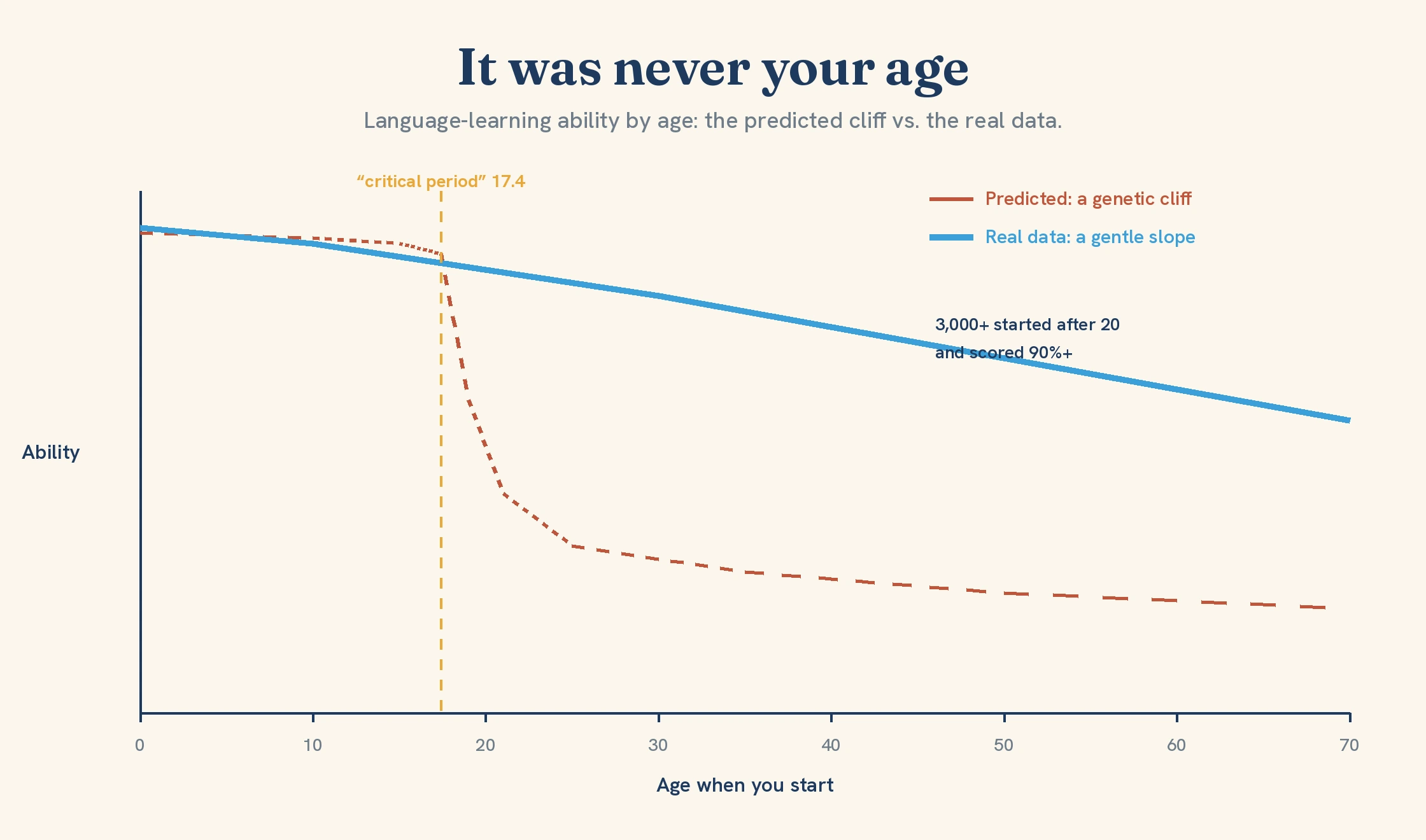
What does this mean? The barrier to learning was never your age or your genetics. It was always the method.
Why does this matter so much? Because the cost of the old way isn’t just slower progress — it’s the millions of people who conclude they are “bad at languages” and quietly give up. They were never bad at languages; they had already mastered one. They were handed a method that hides the language behind rules and lists and then they were the ones blamed for not learning it. Change the method, and the talent turns out to have been there all along.
And my own story makes the point: I reached fluency in Mandarin as an adult in six months, got to native level in less than two years, and learned Cantonese in four months — by learning the way the brain acquires language, not the way schools teach it. I have shared the details of this approach publicly. My TEDx talk on exactly this, “How to Learn Any Language in Six Months,” has been watched more than 37 million times.
That is the method Speech Genie is being built around: the best way to learn a language. It isn’t theory — the technology is already proven and in market as Kungfu English, and a full demo is ready for you to try right now.
Pick English or Mandarin and learn your first real words in your browser — your first two lessons are free, no sign-up. Try the demo →
Short on time? Try a single L2B lesson →
Frequently asked questions
Is immersion the best way to learn a language?
Immersion helps — but only with a method behind it. Dropping into a country with no way to understand what you hear is often months of confusion; exposure isn’t the same as acquisition. Comprehensible, meaning-first input is what turns immersion into actual progress.
What’s the best way to learn a language at home?
The same as anywhere: meaning-first, no translation. You don’t need a classroom or a plane ticket — you need material you can understand from the start, a little every day, with speaking built in early rather than saved for “later.”
What’s the best app to learn a language?
The best app is the one built on how your brain actually learns — meaning-first, not gamified word lists. Most apps drill vocabulary and grammar; look for one that has you understanding and speaking from the very first lesson.
About the author
Chris Lonsdale (龍飛虎) is a psychologist, linguist and educator who reached fluency in Mandarin as an adult in six months, got to native level in less than two years, and learned Cantonese in four months. His TEDx talk, “How to Learn Any Language in Six Months,” has been watched more than 37 million times. He created the Kungfu English learning system — the proven, in-market technology that Speech Genie is now being built on. More at chrislonsdale.com.