

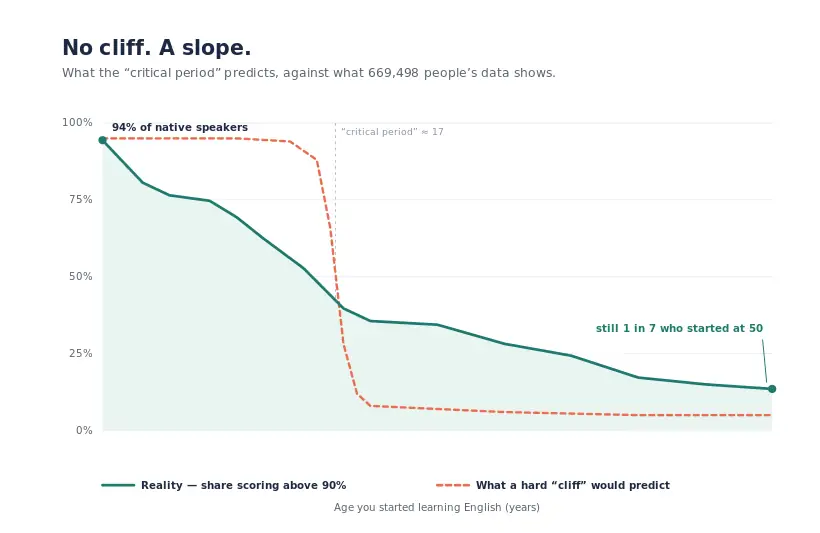
No cliff. A slope. — the study everyone cites to tell you you’re too old to learn a language, and what its own data says.
Somebody told you children are sponges.
That their brains are built for language and yours stopped being built for it a long time ago. Maybe you tried at school and it didn’t take. Maybe you’ve tried since. Either way you filed yourself, quietly, under not a languages person — too old to learn a language, you assumed — and you got on with your life.
There is a scientific-sounding name for the thing you were told. The Critical Period Hypothesis: a window early in life when language goes in easily, and after which it doesn’t. Start really young, or don’t bother.
And in 2018 the largest study of language learning ever run appeared to prove it.
What the study did
Three researchers — Joshua Hartshorne, Joshua Tenenbaum and Steven Pinker — put a grammar quiz online. It went viral. When they closed it they had 669,498 usable responses: two thirds of a million people, native speakers and learners, from everywhere.
They scored 95 items, modelled the results, and reported a finding that went round the world: the ability to learn grammar holds up through childhood and then declines from about 17.4 years old.
A critical period, with a number on it. The headlines wrote themselves.
What the study actually said
Read the paper and the first thing you notice is that the authors are careful about something the headlines were not.
They separate two questions that sound like one. How fast can you learn? and how good can you get? Those are different, and the answer to the first does not give you the answer to the second — because learning takes time, and someone learning more slowly can still arrive, if they keep going.
17.4 is an answer to the first question only. It is the age at which the rate of grammar uptake starts to fall. It is not a ceiling, it is not a deadline, and it is not an age by which you must have started.
Two more things from the same paper that almost nobody quotes.
Immersion learners who began in their late twenties eventually scored higher than the youngest native speakers in the sample. It took them years. They got there.
And native speakers are still improving at their own language until around thirty. Nobody is finished at seventeen. Not even the natives.
Then we counted the people
Curves of averages hide individuals. So we went to the released dataset — all 669,498 rows of it — and counted them.
How many people who started English at 20 or later scored above 90%?
| Started at | People | Scored above 90% | Share |
|---|---|---|---|
| 20–29 | 7,473 | 2,596 | 34.7% |
| 30–39 | 1,685 | 403 | 23.9% |
| 40–49 | 413 | 73 | 17.7% |
| 50–59 | 120 | 19 | 15.8% |
| 60 and over | 29 | 5 | 17.2% |
| All 20 and over | 9,720 | 3,096 | 31.9% |
Nearly one in three people who began at twenty or later scored above ninety per cent.
Not one in a hundred. One in three.
And there is no cliff anywhere in that table. It slopes, gently, and it does not reach zero — people who started in their fifties are still clearing the bar.
Now turn it around. How many native speakers scored below 90%?
16,474.
Sixteen thousand people who grew up speaking English, tested on English grammar, below the line that adult learners are supposedly incapable of reaching — against 3,096 people who started at twenty or later and cleared it.
Those two groups overlap. Heavily. Which is the argument in one sentence: age sorts people far less than the story about age suggests.
How we counted
Four definitions, so you can check us or disagree with us. Every number here is a count of rows in the authors’ own released dataset at osf.io/pyb8s — 669,498 respondents, the same post-exclusion sample the paper analyses — not an estimate and not a model output.
“Native speaker” means the dataset’s own nat_Eng flag: anyone who reported English as a native language — 291,630 people. That group is not all monolingual. 249,749 of them gave English as their only native language; the other 41,881 grew up with English and at least one other. We kept both, because the claim is about people who grew up speaking English, however many languages they grew up with alongside it — and the 16,474 who fell below the bar are counted across the whole group.
“Started at 20 or later” means an Eng_start value of 20 or above — 9,720 people.
“Above 90%” means a graded score above 0.90 on the 95 scored items — more than 85 of the 95 answered correctly.
“No time in an English-speaking country” means an Eng_country_yrs of zero, or with no value recorded — the respondent logged no time there.
Change any of these and the numbers move; these are the four we used.
“They only managed it because they emigrated”
This is the first objection, and it is a fair one. Live in the country, hear the language all day, of course you get good.
Except that is not what the data shows.
Of the 3,096 late starters who scored above 90%, 38.5% logged no time in an English-speaking country at all — a zero, or nothing recorded. Not a short stay. None.
| Started at | Share with no time in an English-speaking country |
|---|---|
| 20–25 | 40.7% |
| 26–30 | 30.7% |
| 31–35 | 35.0% |
| 36–40 | 38.5% |
| 41–50 | 45.6% |
| 51 and over | 53.3% |
And the pattern runs the wrong way for the objection: the older the starter, the more likely they did it without ever living there. Past fifty, most of them did.
Immersion helps. It is plainly not the explanation.
None of this is news. It was published in 2000.
Eighteen years before the big dataset existed, three researchers at Harvard and UBC wrote a paper in TESOL Quarterly arguing that the field had got age wrong in three specific ways. They called them misinterpretation, misattribution and misemphasis.
Misinterpretation. Children are faster at first. That gets read as children being better in the end. They are different claims, and the evidence for the first is not evidence for the second. “These findings,” the authors write, “call into question the alleged advantages of younger learners in foreign language programs and demonstrate that older students can learn more than younger ones in the same period of time.”
Misattribution. Age differences get put down to the brain, when the differences between a five-year-old’s life and a forty-year-old’s — hours available, expectations, whether anyone laughs at you — are never controlled for.
Misemphasis. And this is the one that matters most here. The literature studied adults who failed and paid almost no attention to adults who succeeded. Which is precisely what counting 3,096 people corrects. “They do not demonstrate any constraint on the possibility,” the paper says of the age studies, “that adults can become highly proficient, even nativelike, speakers of L2s.”
Their conclusion, twenty-six years ago: age differences reflect the learning situation, not learning capacity.
Method, not age. Somebody said it in 2000, in a peer-reviewed journal, and the belief carried on regardless.
The objections worth taking seriously
Two, and we would rather raise them than have you find them.
The sample chose itself. This was a viral quiz. The people who take an English grammar quiz for fun, and share the result, are not a random sample of humanity. They are more confident, probably better educated, and quite likely better at English than average. That cuts both ways — it inflates the learners and it means the low-scoring natives are not representative either — but it is a real limitation and the authors say so.
The number moved. In 2021 the same lab ran it again across 1.1 million people with a better model. They put the decline between 17.0 and 18.6 rather than at a point. And they wrote something about their original work that is worth quoting exactly: “the model is biased towards relatively sharp drops in ability.” The famous 17.4 was published with no error bar at all.
There is a third objection nobody has published, and it is the one we find most interesting: 17.4 is also, in most of the world, the age you stop being taught. Leave school, stop studying, stop being made to practise. A study of this design cannot tell a biological window from the end of formal instruction.
So what actually stops adults
Here is what is true about children, and it is not what you were told.
A child takes about five years to hold a decent conversation. Five years — surrounded by the language every waking hour, no job, no bills, and no idea they are supposed to feel silly. They are not fast. They are relentless, and nobody laughs at them.
You have things a four-year-old does not. You know what a sentence is for. You know a thousand things about the world that a child has to learn alongside the words. You can concentrate on purpose.
What you don’t have is five free years. What you do have is the fear of sounding stupid.
Those are the real obstacles. Not your age.
It was never your fault
Every year around 500 million people set out to learn a language and don’t get there. They are not all defective. What they have in common is not their brains — it is the method they were handed: a 240-year-old system invented in Prussia in the 1780s to teach Latin and Ancient Greek, languages nobody was expected to speak.
Translation. Grammar. Memorisation. It suited administrators marking papers. It has never suited anyone trying to talk.
You already mastered a language once, before you could read, before anyone explained a single rule to you. There is nothing wrong with you.
The cliff isn’t there. There is a slope, and you can walk up it.
Where to start
If the cliff was never there, the next question is how to walk the slope well. It comes down to method, not age: seven concrete actions to learn any language fast, the five principles behind them, and the proof it works — how I reached fluency in six months. It is the argument behind the most-watched TEDx talk on language learning, and if you are wondering how long it really takes, that is the honest answer in one place.
Join the waitlist to be first when Speech Genie opens — the method, built as software.
Frequently asked questions
Are you ever too old to learn a language?
No. In the largest study of language learning ever run, nearly one in three people who started English at twenty or older scored above 90% on a hard grammar test — and people who began in their fifties still cleared that bar. What changes with age is how fast you take on new grammar, not whether you can reach a high level.
Is there really a critical period for language learning?
The famous “critical period” figure describes when the rate of grammar uptake begins to slow — around 17 to 18 — not a deadline after which learning stops. The study’s own authors note their model was biased toward finding a sharp drop, and their 2021 follow-up across 1.1 million people softened the picture further.
Do adults only succeed at a language because they moved abroad?
No. Of the late starters who scored above 90%, 38.5% had logged no time in an English-speaking country at all — and the older the starter, the more likely they’d done it without ever living there. Immersion helps; it is not the explanation.
What actually stops adults learning a language?
Not age. Time and the fear of sounding foolish. A child gets five immersed years and nobody laughing at them; an adult gets neither. And the method most people are handed — a 240-year-old grammar-translation system — is the real obstacle, not your brain.
Marinova-Todd, S.H., Marshall, D.B., & Snow, C.E. (2000). “Three Misconceptions About Age and L2 Learning.” TESOL Quarterly, 34(1), 9–34. DOI 10.2307/3588095. Full text: personal.utdallas.edu/~assmann/hcs6367/marinova_todd_marshall_snow00.pdf
Hartshorne, J.K., Tenenbaum, J.B., & Pinker, S. (2018). “A critical period for second language acquisition: Evidence from 2/3 million English speakers.” Cognition, 177, 263–277. DOI 10.1016/j.cognition.2018.04.007. Data: osf.io/pyb8s. Follow-up: Chen, T. & Hartshorne, J.K. (2021), Cognition 214, 104706.