

Immersion: the Natural Method
“Just immerse yourself” is the most repeated piece of language advice on earth — and one of the most misunderstood. People hear it and picture buying a plane ticket, moving abroad, and waking up fluent. Then they go, they struggle, and they come home convinced immersion doesn’t work.
Immersion does work — but not the way most people think, and not by accident. It’s the natural way to learn any language, the same way you learned your first. This article is about how to immerse yourself in a language — and the good news is that you can build most of what you need at home. Throughout I’ll use Mandarin as the running example, because it’s about as far from English as a language gets: if immersion can work for Chinese, it works for anything.
What immersion really means
Let’s clear up the biggest myth first. Immersion does not mean “be in the country.” Millions of people move abroad, surround themselves with a language for years, and still can’t hold a conversation. If simply being there were enough, every long-term expat would be fluent — and they plainly aren’t. So “being there” can’t be the mechanism.
The deeper assumption underneath the myth is that an adult can soak up a language just by being surrounded by it, the way a child does. That’s where it falls apart. A child is immersed in a very particular way: adults slow down, simplify, point at things, repeat, and respond to the child — for years. Nobody does that for a grown adult.
And other adults won’t do it for you. Most people have no interest in interacting with another adult at an infant’s level — unless you’re lucky enough to find someone willing to be your language parent. Drop into a group of native speakers when you can barely speak, and they’ll mostly just talk around you. When they do talk to you, it’s very often at full speed, about complicated things, and then they move on.
So you can rack up thousands of hours of exposure and still never say a word. You’ll unconsciously absorb the sound patterns of the language, but with no meaning attached your brain treats the stream as noise — and it quickly learns to tune it out. That’s the point where most people decide they “can’t do it” and give up.
Here’s the part the myth gets half-right. You can — and should — put yourself in situations where you hear lots of the language without understanding it. But you have to do it in a particular frame of mind. I call that frame of mind brainsoaking: listening with no pressure to understand, letting the sound wash over you. Done in the right state, this kind of listening matters a great deal, because it trains your ear at a deep, physiological level. It just isn’t enough on its own. The natural way includes brainsoaking — but it’s never limited to it.
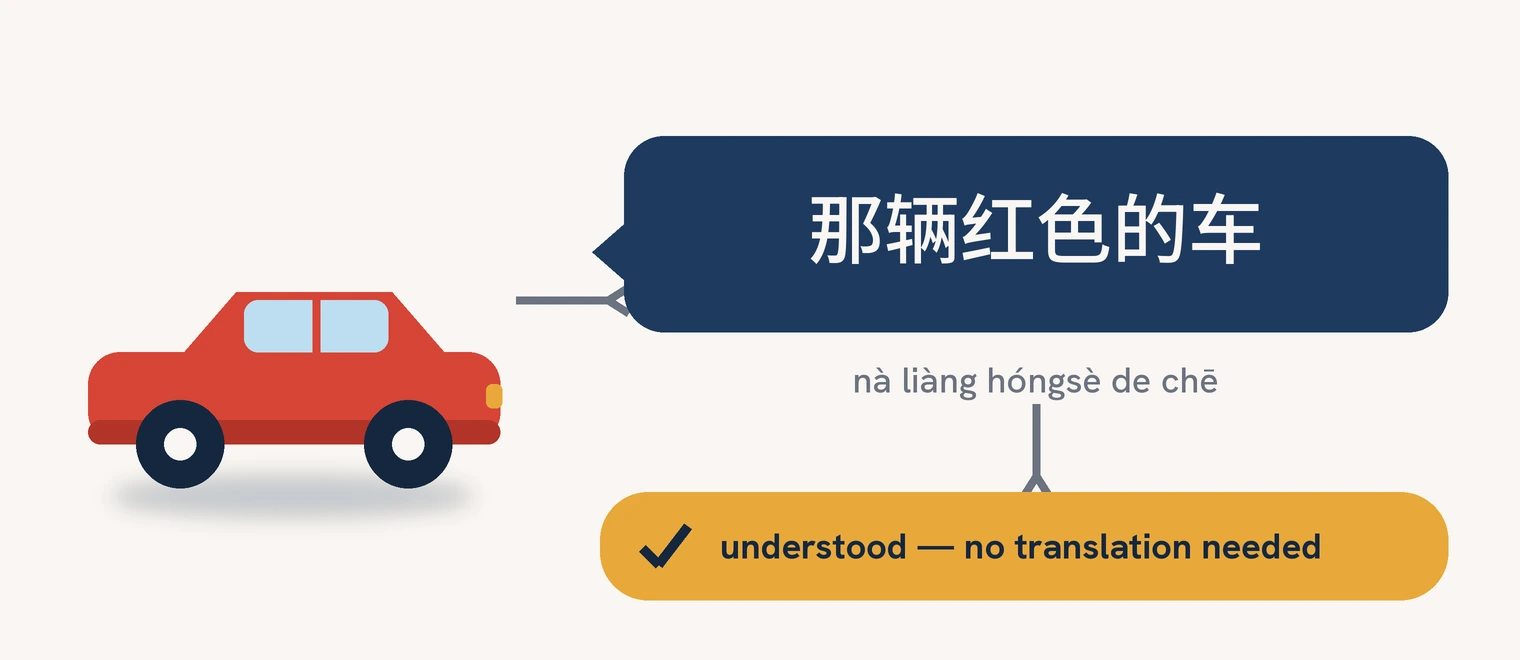
So what does the natural way actually look like in practice? Beyond brainsoaking, it has to include input you can understand — not perfectly, but mostly. Often that’s speech arriving at the same moment your senses tell you what it means: someone points at a red car and says “nà liàng hóngsè de chē,” and you understand, because of what you see and the body language wrapped around the words.
As your foundation grows, you also start to catch speech pitched just a little above where you are now — you understand new things from the way they show up in context. That’s comprehensible input in the classic sense.
The natural way also looks like the same words and patterns coming back at you again and again, in different situations, until they stop sounding foreign. It looks like sound tied to real meaning — a picture, an action, a situation — instead of looking for an English translation. And, crucially, it looks like you eventually opening your mouth and using it. That’s what a child gets, stretched over years. The whole art of immersing yourself in a language as an adult is about engineering those same conditions deliberately, so you absorb the core of it in months instead.
Why it works
This isn’t a hunch; it’s how the brain is built to acquire language. Your brain is a pattern-finding machine. Give it enough understandable input and it extracts the patterns on its own — the sounds, the word order, the rhythms — without you deliberately memorising a single rule. It’s the same process every human who has ever lived used to learn their mother tongue, and it’s the engine behind the approach I laid out in my TEDx talk on learning any language in six months. It’s also built into the Kungfu English system for learners of English in China.
Rules and grammar tables can describe a language after the fact. They can’t install it. Only comprehensible input, wired to meaning, does that.
Language immersion at home: build the stack
You don’t need a plane ticket. Language immersion at home is really just a stack of understandable input you can run every day. Using Mandarin as the example, four layers do most of the work — and the same four work for any language:
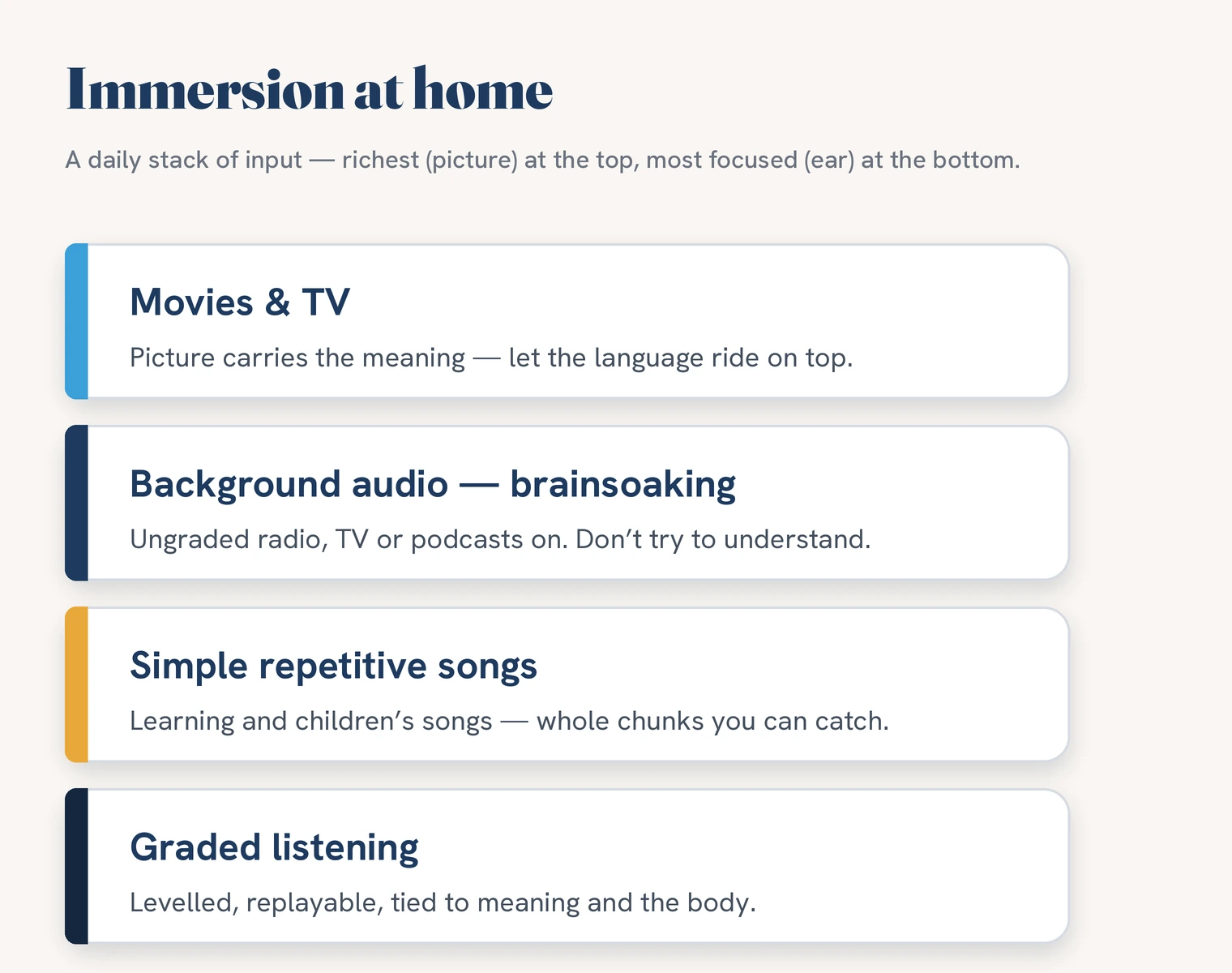
- Learning a language with movies and TV is the richest layer, because the picture carries a lot of the meaning. Start with shows where you can follow the story from the action alone, and let the language ride on top of what you already understand. The more a show lets you connect what you hear to what you see, the better: physical objects that get named, and feelings that are obvious and named — somebody frowns and another character says “why don’t you like that?”, and you connect those words to a feeling you recognise and an expression you can see on someone’s face.

- Background audio — your brainsoaking layer, and it’s ungraded on purpose: radio, the TV chattering away, podcasts you simply let run. The trick is the opposite of studying — don’t try to understand it. Just let it play while your ear soaks up the patterns. Done this way, this is immersion learning by listening, with no effort required — and podcasts are ideal for it. I picked up a lot of my Cantonese this way: partly from listening to taxi drivers on their CB radios, and partly from a colleague behind me who was always on the phone. In Speech Genie we use a reading of my Chinese book How to Learn Any Language in Six Months as the brainsoaking content to learn Mandarin Chinese — you can hear it in the demo.
- Songs work — but only the right kind. Use clearly-enunciated, highly repetitive songs built around whole phrases and chunks — think learning songs and children’s songs — where the words are easy to catch. Normal pop songs are the opposite: the lyrics are notoriously hard to make out even for native speakers, so as a beginner you’ll learn almost nothing from them.
- Graded listening — short meaningful phrases you can replay, tied to meaning, to systematically build your ear’s ability to actually hear the new sounds. Early on, as much as possible, listen to language that is connected to things you can see, touch and do — grounded in the body. Once that’s in place, you can add new layers of speech a little at a time, on top of what you already know. Language to Body is designed specifically to guide you through this process.
The i+1 rule
The principle behind all of this has a name the linguist Stephen Krashen gave it: i+1. “i” is your current level; “+1” is input pitched just one notch above it — hard enough to stretch you, easy enough to understand. That sweet spot is where acquisition happens. It’s the technical way of labelling comprehensible input, and it’s really describing the new words you hear or see in the context of words you already know.
This generally happens when you’re reading a story and there are only a few words you don’t know. Your brain picks up their meaning from context, because of its knack for recognising the overall pattern from everything you do understand.
Here’s the catch nobody tells you: i+1 only really matters once you already have a basic foundation in the language. It’s when you’re building on that foundation that i+1 becomes great guidance — for choosing materials to read or hear that will grow your vocabulary.
For a complete beginner, though, i+1 doesn’t make sense, because everything you hear is i + “a-whole-lot-of-stuff-I-don’t-understand.” There’s no way to get any context, so you comprehend nothing.
At the beginner level you have to use your five senses to create comprehensible input. You see a  , you hear the label niǎo, and your brain gets that niǎo = . Once you have a set of words for objects and actions you already understand, short phrases with just one unknown word are how you start building further.
This is the real case for a designed course over a pile of random content: a course built to add language progressively — a little at a time, with heavy repetition across many different contexts — keeps you in the i+1 zone automatically, so the input is always understandable and always stretching you. That’s the single hardest thing to do for yourself, and the single most valuable thing a good course does for you.
Active vs passive listening — how to make hours count
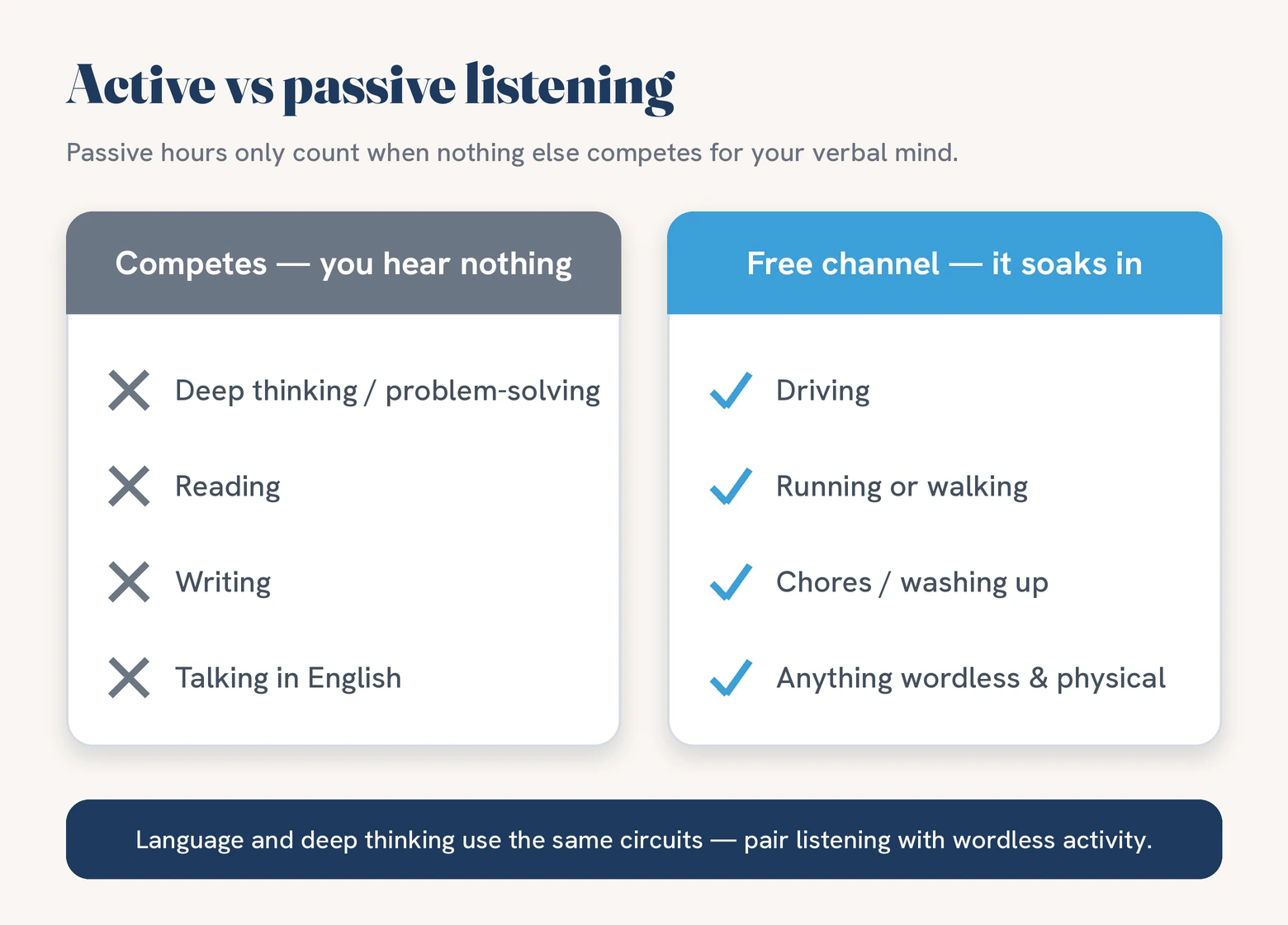
Passive listening — having the language playing while you do something else — is far more powerful than people think, with one strict condition: nothing else can be competing for the same part of your brain. Language and deep thinking fight for the same circuits. So the test is simple. If the other activity uses your verbal mind — reading, writing, holding a conversation in English, anything where you’re thinking in words — the listening does nothing, because your attention isn’t on it. But if the other activity is physical and wordless — driving, running, walking, doing chores — your verbal channel is free, and the language soaks in. Stack your passive hours onto those wordless activities and they genuinely add up. Stack them on top of study or screens, where you’re already working mentally, and you’re fooling yourself — you’ll literally hear nothing.
Build a Mouth!
Pairing immersion with speaking
Immersion builds comprehension. It does not, on its own, build a mouth. You can understand everything you hear and still freeze when it’s your turn to talk — because speaking is a physical skill, and physical skills are built by doing, not by listening. So the natural method has two halves that work together: take language in until you understand it, then practise saying it until it sounds right. After that, start connecting ideas to the sounds you can already make, and begin producing speech — starting with single words or very short chunks of two or three words that carry meaning, and building out from there.

In practice that means opening your mouth early and often, even while you can understand far more than you can say. Copy the model out loud — this is exactly what FaceFonics® is built for: the mouth on the screen, the sound in your ears, your own mouth copying along — and say it straight back. Take the chunks you already understand from your listening and say them aloud, over and over, until they come out without effort. Your listening feeds your speaking, and speaking sends you back to your listening sharper — so run the two together, not as separate activities.
A 30-day at-home immersion starter
If you want something concrete to begin tomorrow, here’s a month that puts all of the above to work without leaving home:
- Every day — 20–30 minutes of brainsoaking.
- Every day — 15–20 minutes of focused, understandable input, ideally requiring you to respond non-verbally in some way. This can be done in short bursts of maybe 5–7 minutes at a time.
- Every day — 5–10 minutes of speaking out loud: copy the model, repeat the chunks, and get them into your mouth.
- Weekly — add one notch of difficulty. Swap in a slightly harder show or a longer passage so you stay at i+1 and never plateau.
Thirty days of that and you won’t be fluent — but your ear will have changed, your mouth will have started moving, and you’ll have proven to yourself that the natural way works.
That’s exactly what Speech Genie is built to give you: understandable input, wired straight to meaning, sequenced so you’re always at i+1, with your mouth in the loop from the start — the natural method, engineered, with brainsoaking, listening and speaking all in one place. Learn your first real sounds — Mandarin or English — in your browser, free and with no sign-up. Play a free lesson →
About the author
Chris Lonsdale (龍飛虎) is a psychologist, linguist and educator who reached fluency in Mandarin as an adult in six months, got to native level in less than two years, and learned Cantonese in four months. He developed Language to Body, a digital form of Total Physical Response, and created the Kungfu English learning system that Speech Genie is built on. His TEDx talk, “How to Learn Any Language in Six Months,” has been watched more than 37 million times. More at chrislonsdale.com.