

The easiest language to learn is usually the one closest to what you already speak — but how easy any language feels depends far more on your method than on the language itself.
The short answer: choose the language that overlaps most with one you already know
Every language you already speak is a head start. The more a new language shares with it — vocabulary, alphabet, sentence structure, even the sounds — the shorter the climb, because your brain recognises patterns it already has instead of building them from scratch. Learning is pattern-matching and overlap hands your brain a stack of patterns for free.
If you speak English, the Romance languages — Spanish, Italian, French, Portuguese — hand you thousands of words you already half-recognise (nation / nación, important / importante, family / famiglia), because English borrowed heavily from Latin and French centuries ago. If you speak Mandarin, Cantonese shares the writing system and most of the vocabulary; the spoken form mainly adds a few extra tones. If you already speak Spanish, Italian and Portuguese are almost a free ride. The principle never changes: overlap shortens the distance.
What’s the easiest language to learn for English speakers?
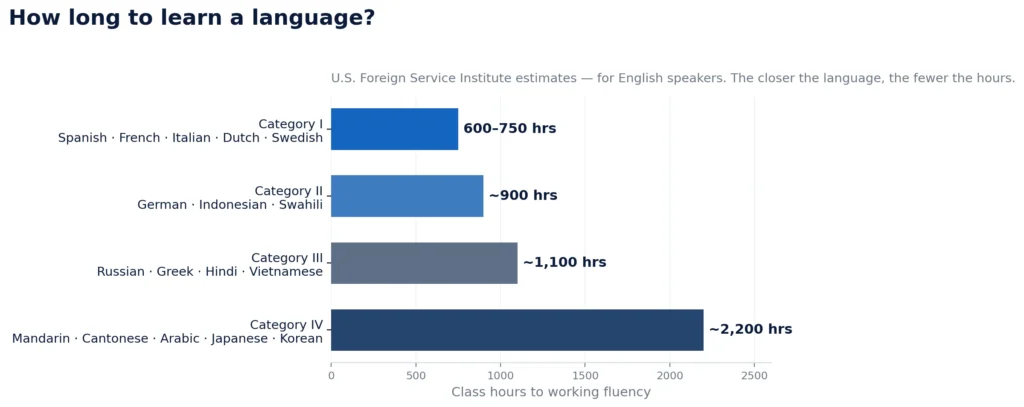
For native English speakers, the languages most often rated easiest are the ones closest to English in vocabulary and structure. The U.S. Foreign Service Institute — which has trained diplomats for decades — groups languages by how many class hours its students typically need to reach working fluency. Its easiest tier, roughly 600–750 hours, is almost entirely the languages that overlap most with English:
- Spanish, Italian, French, Portuguese and Romanian — Romance languages packed with vocabulary an English speaker already half-knows.
- Dutch, Norwegian, Swedish and Danish — Germanic cousins of English with familiar word order and rhythm.
These feel “easy” not because they are simple languages, but because so much of these languages is already sitting in an English speaker’s head. Spanish adds a bonus: it is close to phonetic, so words are said the way they are written — which removes one of the biggest sources of friction for beginners.
Why is this? It’s simply due to how your brain actually learns language. You learn language from childhood by storing sound patterns in your brain. When you hear a new language that has similar sound patterns to the language you already speak, it’s much easier for your brain to make those new connections. Basically, you already have the sound patterns mapped in your head!
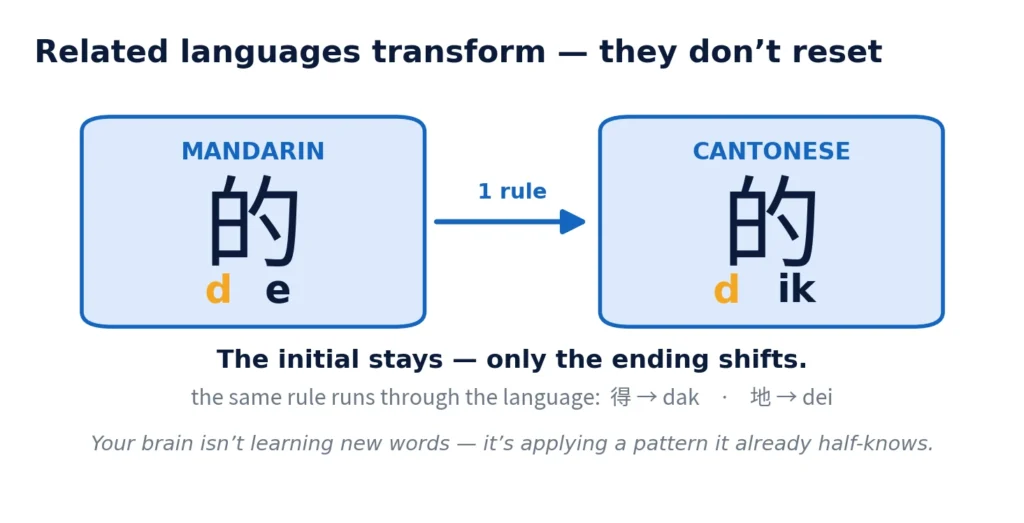
This even holds when two related languages sound different on the surface. The differences are usually regular — a handful of consistent transforms turn one into the other. Mandarin 的 (de) becomes Cantonese dik: the d-sound stays put, only the ending shifts, and the same rule runs right through the language. So your brain isn’t building these from scratch — it’s applying a pattern it already half-knows.
What the easiest-language lists miss: “easy” is mostly about method
Choosing by overlap is a fine tie-breaker. But it quietly accepts a false premise — that some languages are simply hard and others simply easy. The bigger truth is that how you learn matters far more than what you learn.
Almost every language course on earth still teaches the way schools have for two centuries: translate, memorise vocabulary lists, drill grammar rules. That method makes every language feel hard, because you are not learning the language — you are learning about it, in your own language, one rule at a time. The translation step is the bottleneck, and it is there no matter which language you pick.

Learn the way a child does instead — meaning first, sound connected straight to experience, no translating in your head — and almost any language opens up. A child in Beijing masters Mandarin’s tones and thousands of characters without a single grammar lesson. A child in Cairo handles Arabic’s script and sounds the same way. They are not gifted; they are using the system the brain is built for. Give an adult that same method and the “hard” languages stop being hard.
So is there a hardest language?
Languages like Mandarin, Cantonese, Arabic, Japanese and Korean sit in the Foreign Service Institute’s most demanding tier — often 2,200 hours or more by the traditional method. But that number measures the method, not your brain. These languages simply carry features the translate-and-memorise approach handles badly: tones, a non-Latin script, characters instead of an alphabet. Every language brings its own kind of challenge — tones in one, a new alphabet in another, grammatical gender in a third — and none of them is “hard” in any absolute sense.
The proof is personal. I created the Kungfu English learning system that Speech Genie is built on, and as an adult I reached native-level Mandarin and went on to learn Cantonese — two of the very languages those difficulty charts call the hardest on earth — in a matter of months. Not because I have a gift for languages, but because I stopped translating and started learning the way the brain actually acquires language. My TEDx talk on exactly this, “How to Learn Any Language in Six Months,” has been watched more than 37 million times.
What you should actually do
If you have no particular language in mind and just want the gentlest start, pick one that overlaps with a language you already speak — for an English speaker, that usually means Spanish or another Romance language. You will feel progress quickly, and early momentum is what keeps people going.
But if there is a language you genuinely want — the one your partner speaks, the country you love, the films you wish you understood — do not talk yourself out of it because a list called it “hard.” Motivation beats ease every time, and with the right method the gap between “easy” and “hard” languages shrinks far more than those charts suggest. What actually decides whether you succeed is not the language you pick. It is whether you learn it the way your brain was built to.
That is the whole idea behind Speech Genie, and why I built it: drop the translation habit, learn meaning-first the way a child does, and “easy or hard” stops being about the language at all. You can try it free right now on this page — pick English or Mandarin and learn your first real words in your browser, no sign-up.
Play the lesson full-screen
On a phone the lesson works best on its own screen. Tap below to open it, then come back here when you’re done.
▶ Play the lesson →Tip: turn your phone sideways for more room.New to this? Here’s how language-to-body works →
Ready for the whole thing? Try the complete Speech Genie demo →
Frequently asked questions
About the author
I’m Chris Lonsdale — a psychologist, linguist and educator, and the creator of the Kungfu English learning system that Speech Genie is built on. I reached native-level Mandarin as an adult and learned Cantonese in a matter of months, and my 2013 TEDx talk, “How to Learn Any Language in Six Months,” has been watched more than 37 million times. Read more at chrislonsdale.com.